

Understanding Different Types of Boring Bars and Their Use
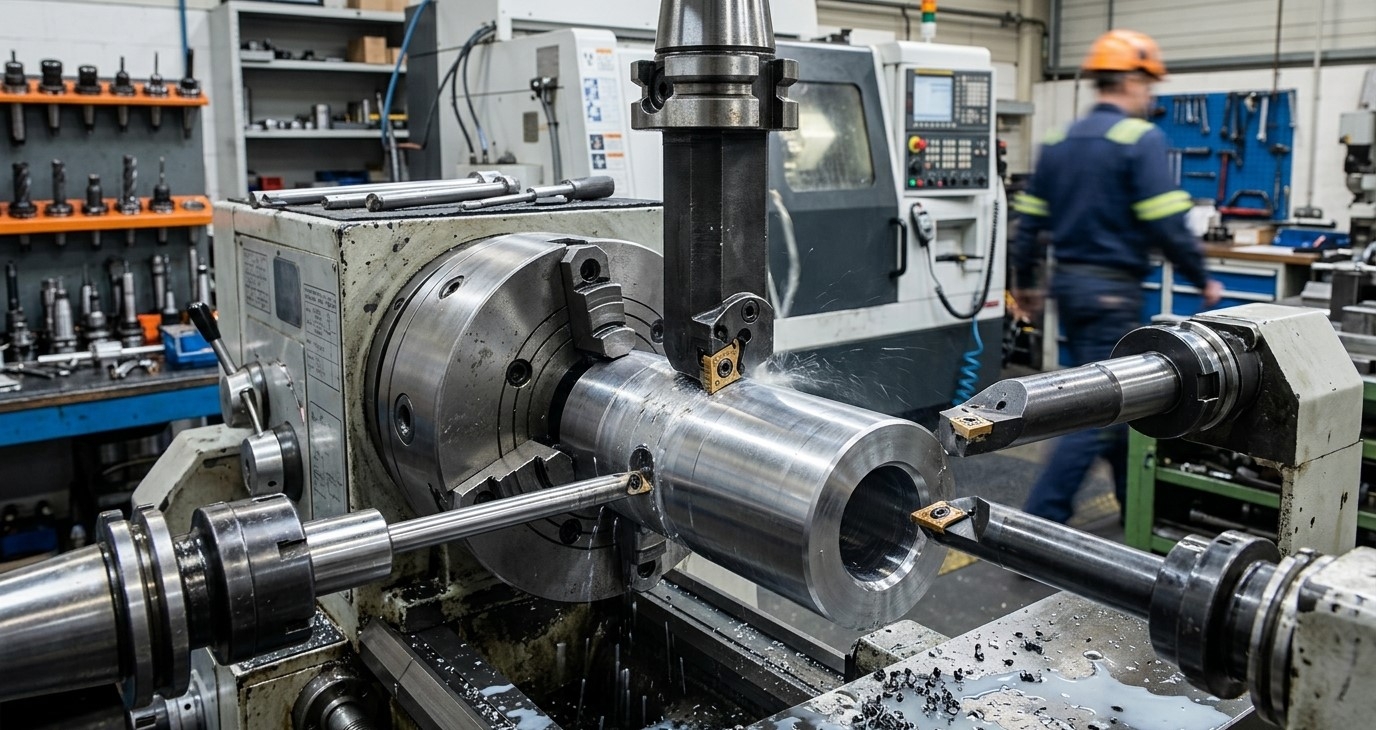
Boring is an important machining operation used to enlarge, refine, and improve the accuracy of existing holes in a workpiece. Unlike drilling, which creates a new hole, boring removes material from an existing opening to achieve a specific diameter, alignment, depth, and surface finish. The quality of a boring operation depends heavily on selecting the right boring bar for the application.
Different boring bars are designed for different materials, hole sizes, depths, machine configurations, and machining conditions. Choosing an unsuitable bar can result in vibration, chatter, poor surface finish, dimensional inaccuracies, and premature tool wear. For manufacturers and engineering workshops, understanding boring bar types and their applications is therefore essential for achieving reliable machining results.
Khokhawala Trading LLC, an experienced Industrial Tools Supplier in Dubai, provides industrial cutting tools, carbide cutting tools, CNC machining tools, machining accessories, and precision measuring tools for a wide range of manufacturing and engineering requirements.
What Is a Boring Bar?
A boring bar is a cutting tool used to enlarge or finish an existing hole. It typically consists of a rigid shank with a cutting edge or replaceable insert positioned at the end or side of the bar.
Boring bars can be used on:
- CNC turning machines
- CNC machining centers
- Conventional lathes
- Horizontal boring machines
- Vertical machining systems
- Specialized boring equipment
Depending on the design, boring bars can perform rough boring, finish boring, internal profiling, shoulder machining, and other internal turning operations.
Boring vs. Drilling
Boring and drilling are often confused, but they serve different purposes.
Drilling is primarily used to create a new hole in solid material.
Boring is performed on an existing hole to enlarge it, improve its geometry, or achieve a more accurate diameter and surface finish.
For example, a drilled hole may not meet the final dimensional tolerance required for a precision component. A boring operation can then be used to bring the hole closer to its final specification.
This makes boring an important process for precision manufacturing.
Why Boring Bar Selection Matters
The boring bar must withstand cutting forces while maintaining adequate rigidity. Because boring takes place inside a hole, the available space for the tool is limited.
The correct boring bar can help provide:
- Improved hole accuracy
- Better surface finish
- Reduced vibration
- Longer tool life
- Better chip control
- Consistent machining performance
- Reduced risk of tool failure
- Improved productivity
Tool selection becomes especially important when machining deep holes or using small-diameter boring bars.
Common Types of Boring Bars
There are several types of boring bars used in industrial machining. Each has advantages depending on the application.
1. Solid Carbide Boring Bars
Solid carbide boring bars are manufactured entirely from carbide. Their high stiffness relative to their size makes them suitable for smaller-diameter internal machining applications where rigidity is critical.
They can help reduce vibration and deflection when compared with less rigid bar designs of similar dimensions.
Solid carbide boring bars are commonly used for precision finishing operations and small internal diameters.
2. Steel Boring Bars
Steel boring bars are widely used for general-purpose internal machining. They are available in different diameters and lengths and can be suitable for many conventional and CNC applications.
Steel bars can provide good toughness, but long bars may be more susceptible to deflection and vibration.
For shallow or moderately deep boring operations, steel bars can provide a practical solution.
3. Carbide-Tipped Boring Bars
Carbide-tipped boring bars combine a steel body with a carbide cutting tip or insert. They can provide a balance between toughness and cutting performance.
These bars may be suitable for applications requiring a stronger body while still benefiting from a carbide cutting edge.
4. Indexable Boring Bars
Indexable boring bars use replaceable carbide inserts. When an insert becomes worn, it can be rotated or replaced without replacing the entire bar.
Advantages include:
- Multiple cutting edges
- Quick insert replacement
- Consistent tool geometry
- Reduced tool replacement time
- Availability of different insert grades
Indexable boring bars are widely used in CNC machining and production environments.
5. Anti-Vibration Boring Bars
Anti-vibration or damped boring bars are designed to reduce vibration during long-overhang internal machining.
When a boring bar extends deeply into a hole, the bar can behave like a cantilever. This increases its sensitivity to vibration.
Damped bars incorporate design features intended to absorb or reduce vibration, making them useful for deep-hole machining.
6. Small-Diameter Boring Bars
Small-diameter boring bars are designed for machining relatively small internal holes.
Because their cross-sectional area is limited, rigidity becomes especially important. Solid carbide designs are often considered for these applications because they can provide high stiffness relative to diameter.
7. Rough Boring Bars
Rough boring bars are designed for higher material removal rates. They are generally used to remove substantial amounts of material before a finishing operation.
Rough boring requires a strong cutting edge and stable machining setup because cutting forces can be relatively high.
8. Finish Boring Bars
Finish boring bars are designed for achieving accurate dimensions and good surface finish.
They are typically used after rough boring has brought the hole close to its final size.
Finish boring requires careful control of tool geometry, cutting parameters, tool runout, and workpiece stability.
Boring Bar Materials
Boring bar material affects rigidity, toughness, vibration resistance, and application suitability.
Steel
Steel provides good toughness and is widely used for general-purpose boring.
Carbide
Carbide offers high stiffness and wear resistance. It is particularly useful for small-diameter and precision boring applications.
Damped Designs
Damped boring bars are used when vibration control is a major concern, particularly during long-reach operations.
The material and design should be selected according to hole diameter, overhang, cutting conditions, and required accuracy.
Choosing the Right Boring Bar Diameter
Boring bar diameter should be selected according to the available hole diameter and required machining depth.
A larger bar generally provides greater rigidity, while a smaller bar is required for smaller holes.
The goal is to use the largest practical boring bar that fits within the hole and provides the necessary clearance.
Using a bar that is unnecessarily small can increase deflection and vibration.
Tool Overhang and Rigidity
Overhang is one of the most important factors in boring.
As the bar becomes longer relative to its diameter, its resistance to bending decreases significantly. Excessive overhang can result in:
- Chatter
- Tool deflection
- Poor surface finish
- Dimensional inaccuracies
- Accelerated insert wear
- Tool breakage
Whenever possible, minimize the boring bar's unsupported length.
For deep holes, specialized anti-vibration or damped boring bars may be more appropriate.
Selecting the Correct Boring Insert
For indexable boring bars, the insert must match the bar and machining operation.
Important considerations include:
- Insert shape
- Grade
- Coating
- Nose radius
- Clearance angle
- Chip breaker
- Workpiece material
- Roughing or finishing requirements
Carbide cutting tools with appropriate insert grades can provide reliable performance across many industrial boring applications.
Boring Bar Geometry
Geometry affects cutting forces, chip formation, and surface finish.
A suitable clearance angle prevents unnecessary rubbing between the tool and workpiece. Nose radius affects cutting strength and surface finish.
A larger nose radius can provide greater edge strength but may increase cutting forces. A smaller nose radius may reduce cutting forces and improve access but can be more vulnerable under heavy cutting conditions.
The correct geometry should be selected according to the operation and material.
Boring Different Materials
Steel
Steel can generally be bored using suitable carbide inserts and conventional boring bars. Grade and geometry should match the material hardness and cutting conditions.
Stainless Steel
Stainless steel may generate significant heat and can work harden. Appropriate geometry, grade, and cutting parameters can help manage these conditions.
Cast Iron
Cast iron can be abrasive, making wear resistance important for many applications.
Aluminum
Aluminum often benefits from sharp cutting edges and suitable chip evacuation to reduce material adhesion.
Hardened Materials
Hardened workpieces may require specialized carbide or advanced cutting materials depending on hardness and machining requirements.
Cutting Parameters for Boring
Proper cutting parameters are essential for stable boring.
Cutting Speed
Cutting speed affects temperature, tool wear, and productivity. Excessive speed may accelerate wear, while overly conservative speed can reduce efficiency.
Feed Rate
Feed influences surface finish and cutting forces. The appropriate feed depends on insert geometry, nose radius, material, and depth of cut.
Depth of Cut
Rough boring may use a larger depth of cut, while finishing generally uses lighter cuts to achieve the required dimensions and surface finish.
Manufacturer recommendations should be used as the starting point for selecting cutting parameters.
Coolant and Chip Evacuation
Coolant can help control heat and improve chip evacuation when appropriate for the workpiece and tooling.
Chip evacuation can be especially challenging during deep internal machining because chips have limited space to escape.
Proper coolant direction, internal coolant delivery where supported, air blast, and suitable insert geometry can help manage chips.
Common Boring Problems
Chatter and Vibration
Chatter is one of the most common boring problems. It may be caused by excessive overhang, inadequate rigidity, unsuitable cutting parameters, or poor workholding.
Poor Surface Finish
Poor finish may result from vibration, worn inserts, incorrect feed, unsuitable nose radius, or tool deflection.
Incorrect Bore Diameter
Dimensional errors may be caused by tool deflection, thermal effects, incorrect tool offsets, insert wear, or machine setup issues.
Tool Wear
Excessive cutting speed, unsuitable insert grade, poor coolant management, and difficult materials can accelerate tool wear.
The Role of Precision Measurement
Boring operations are often used to achieve tight dimensional tolerances, making measurement essential.
Precision measuring tools such as bore gauges, internal micrometers, micrometers, dial indicators, and other inspection instruments can be used to verify:
- Bore diameter
- Bore depth
- Roundness
- Alignment
- Concentricity
- Surface-related requirements
Regular measurement helps detect tool wear and dimensional drift before multiple components are affected.
Best Practices for Boring Operations
For consistent boring performance, workshops should:
- Use the largest practical boring bar diameter.
- Minimize tool overhang.
- Select the boring bar according to hole diameter and depth.
- Use appropriate insert geometry and grade.
- Maintain rigid workholding.
- Control tool runout.
- Follow recommended cutting parameters.
- Ensure effective chip evacuation.
- Monitor insert wear regularly.
- Check bore dimensions with appropriate measuring equipment.
These practices can improve machining stability and reduce unnecessary downtime.
Applications of Industrial Boring Bars
Boring bars are used in many industries, including:
- Automotive manufacturing
- Aerospace
- Oil and gas
- Heavy equipment
- General engineering
- Energy equipment
- Machinery manufacturing
- Fabrication
- Maintenance and repair
- Precision component production
Typical applications include machining bearing housings, engine components, sleeves, bushings, hydraulic components, shafts, cylinders, and other parts requiring accurate internal features.
Benefits of Using the Right Boring Bar
Selecting the appropriate boring bar can provide:
- Improved bore accuracy
- Better surface finish
- Reduced vibration
- Longer tool life
- Improved chip control
- Higher productivity
- Reduced tool changes
- More consistent component quality
- Lower risk of tool failure
- Better machining efficiency
For production machining, these benefits can contribute to lower operating costs and more predictable manufacturing performance.
Conclusion
Boring bars are essential CNC machining tools for enlarging and finishing existing holes with controlled dimensions and surface quality. From steel and solid carbide bars to indexable, small-diameter, roughing, finishing, and anti-vibration designs, different boring bars are suited to different machining requirements.
When selecting a boring bar, manufacturers should consider hole diameter, machining depth, workpiece material, tool overhang, rigidity, insert geometry, cutting parameters, coolant requirements, and required dimensional accuracy. Proper tool holding and suitable machining accessories are equally important for maintaining a stable machining setup.
For businesses seeking reliable industrial tooling solutions, Khokhawala Trading LLC offers a range of industrial cutting tools, carbide cutting tools, CNC machining tools, machining accessories, and precision measuring tools for engineering and manufacturing applications. As an established Industrial Tools Supplier in Dubai, Khokhawala Trading LLC supports workshops and industrial businesses with tooling solutions for diverse machining requirements.
Choosing the correct boring bar can make a significant difference in internal machining performance. With the right combination of tool rigidity, insert selection, cutting parameters, workholding, and measurement, manufacturers can achieve accurate bores, reliable tool life, and consistent production results.
- Goth Lifestyle
- Fashion & Style
- Music & Bands
- Art & Photography
- Creative Writing & Poetry
- Events & Scene
- Occult & Spirituality
- DIY & Tutorials
- Beauty & Self-Care
- Relationships & Dating
- Gaming & Media
- Tech & Gadgets
- Body Art & Piercings
- Underground Culture
- Spotlights & Interviews
- Travel & Places
- Lifestyle & Daily Life
- Fitness & Health
- Travel & Adventure
- Books & Literature
- Tech & Gaming
- Movies & TV
- Food & Drinks
- Humor & Memes
- Pets & Animals
- General Arts & Crafts

 English
 Arabic
 French
 Spanish
 Portuguese
 Deutsch
 Turkish
 Dutch
Dutch
 Italiano
 Romaian
 Portuguese (Brazil)
 Greek
Greek