


SEO in 2026: How Businesses Can Build Visibility Beyond Google Rankings
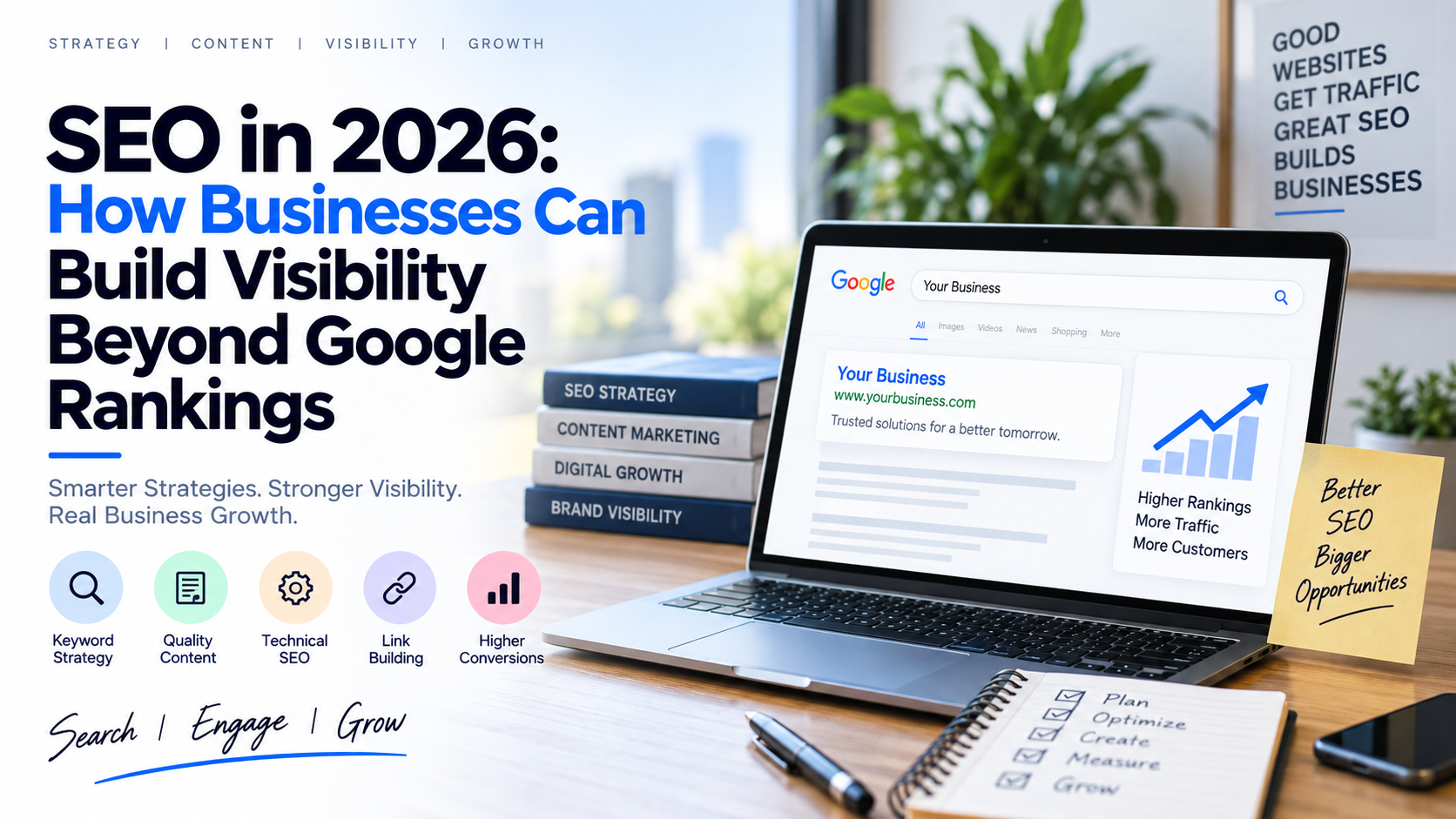
Search engine optimization has changed considerably over the years. Earlier, businesses often focused on ranking for a list of keywords and building backlinks. Today, successful SEO requires a much broader approach that combines useful content, technical performance, search intent, website experience, brand trust and continuous improvement.
Google's current guidance emphasizes helpful, reliable and people-first content rather than content created primarily to manipulate search rankings. Google has also stated that its existing SEO fundamentals remain relevant for AI features such as AI Overviews and AI Mode.
For businesses, this means SEO should not be treated as a short-term ranking exercise. It should be part of a long-term digital strategy designed to help the right audience discover useful information and take meaningful action.
What Has Changed in SEO?
Search behaviour is becoming more conversational and detailed. Users may search through traditional Google results, ask follow-up questions in AI-powered experiences, watch videos, check local results or explore a company's website before making a decision.
This makes visibility more complex than simply appearing for one keyword.
A business needs content that answers important customer questions, pages that clearly explain its services and a website that search engines can properly crawl and understand.
Google's 2026 guidance for generative AI search specifically recommends applying foundational SEO practices while creating unique, valuable content rather than relying on separate AI-search tricks.
Start SEO With Search Intent
Keywords are still useful, but the reason behind a search is equally important.
Consider someone searching for "SEO."
They could be learning what SEO means, researching SEO strategies or looking for an SEO agency in Noida.
These users have different needs.
A good SEO strategy identifies the intent behind searches and creates content that matches those needs. Informational searches may require detailed guides, while commercial searches may require service pages, comparisons, case studies and clear business information.
This approach also helps prevent unnecessary content duplication because one useful page can answer multiple closely related searches naturally.
Create Content That Adds Something New
Publishing content simply to target keywords is not enough.
Google's people-first content guidance encourages original information, research, analysis and substantial value rather than content that simply rewrites what is already available online.
For example, instead of publishing another generic article about SEO basics, a business could share:
- Practical campaign experiences
- Original examples
- Website audits
- Industry observations
- Screenshots or data
- Common customer questions
- Step-by-step processes
This type of information can make an article more useful and demonstrate genuine knowledge.
For a Best SEO Company in Noida, for example, demonstrating actual SEO processes and explaining how decisions are made can be more informative than repeatedly claiming to be the best.
Build Strong Service Pages
Blogs are only one part of SEO.
Businesses offering professional services should also create detailed service pages that clearly explain what they provide, who the service is for, how the process works and what customers can expect.
A page targeting SEO marketing company Noida should not simply repeat the keyword throughout the page. It should explain the actual service, methodology, areas covered, reporting process and relevant customer questions.
Similarly, a page targeting Local SEO Services Noida should provide information specifically relevant to businesses trying to improve their local online visibility.
The page should be genuinely useful even if the visitor has never heard of the company before.
Technical SEO Still Matters
Great content needs a technically accessible website.
Search engines need to be able to discover, crawl and understand important pages. Google recommends making sure websites meet technical requirements and that developers consider factors such as security, speed, accessibility and compatibility across devices.
Important technical areas include:
Crawlability: Search engines should be able to access important pages.
Indexability: Pages that should appear in search need to be eligible for indexing.
Mobile experience: Pages should work properly across different screen sizes.
Page performance: Visitors should be able to access content without unnecessary delays.
Internal linking: Important pages should be connected logically so users and search engines can discover related content.
Technical SEO is not about adding hundreds of complicated settings. It is about removing barriers that prevent users and search engines from accessing useful information.
Internal Linking Creates a Stronger Website Structure
Internal links are often overlooked.
A well-planned internal linking structure can connect related articles, service pages and important business information.
For example, a digital marketing website might connect an SEO guide to its SEO services, local SEO content, content marketing guide and technical SEO resources.
This creates topical relationships between pages and gives readers useful next steps.
Google's AI-search documentation also recommends making content easy to find through internal links.
The links should be added naturally where they help the reader rather than inserting links into every paragraph.
SEO Is Moving Toward Topic Depth
Businesses should think about topics rather than isolated keywords.
Suppose a company wants to build authority around SEO.
One article about SEO may not be enough to cover the subject properly. A broader content structure could include technical SEO, local SEO, keyword research, on-page SEO, SEO for small businesses, content strategy, link building and measuring SEO performance.
These articles can then connect to a main service page.
This creates a logical information structure and gives visitors multiple ways to explore the subject.
E-E-A-T and Trust Matter
SEO content should give readers reasons to trust the information.
Google describes E-E-A-T as experience, expertise, authoritativeness and trustworthiness, while also noting that E-E-A-T itself is not a specific ranking factor.
Businesses can make expertise more visible by providing author information, explaining their experience, showing relevant examples, publishing original insights and making company information easy to verify.
For professional services, case studies and transparent processes can be particularly useful because they show how the company approaches real problems.
SEO and AI Search Work Together
AI-powered search has created new conversations around terms such as AEO and GEO. However, Google's current guidance says that there are no additional technical requirements or special optimizations required to appear in AI Overviews or AI Mode. Existing SEO fundamentals continue to matter.
This means businesses should focus on creating content that is:
Useful + Original + Clear + Accessible + Trustworthy
Instead of creating separate pages for every possible AI query, businesses should build comprehensive resources that genuinely answer customer questions.
Google's 2026 guidance also warns against creating large amounts of content for every possible query variation primarily to manipulate search or AI visibility.
Don't Ignore Local SEO
Local businesses need a strategy that connects their website with their local audience.
For a business targeting Noida, for example, local SEO may involve relevant service pages, accurate business information, useful local content and a well-maintained Business Profile.
The goal should be to demonstrate genuine relevance to the location rather than simply adding the city name repeatedly.
This is particularly important for businesses targeting searches such as SEO service provider Noida, SEO strategy consultant Noida or other location-specific services.
Measure SEO With More Than Rankings
Rankings can provide useful information, but they are not the only metric that matters.
Businesses should also monitor organic clicks, impressions, click-through rate, conversions, qualified leads and the performance of individual landing pages.
Google Search Console can help website owners understand how their pages perform in Google Search and identify areas that may need attention.
For example, if a page receives many impressions but few clicks, its search appearance may need improvement. If a page receives traffic but generates no enquiries, the problem may be related to content, user experience or conversion rather than rankings alone.
Avoid Common SEO Shortcuts
Some SEO tactics may appear attractive because they promise quick results, but they can create long-term problems.
Businesses should avoid:
Keyword stuffing: Repeating the same phrase unnaturally makes content less useful.
Mass-produced low-value articles: More pages do not automatically mean better visibility.
Unnatural link building: Links should support genuine discovery and authority rather than manipulate rankings.
Duplicate location pages: Creating nearly identical pages only by changing city names can provide little value.
Writing only for search engines: Content should primarily satisfy the people who read it.
Google's Search Essentials and spam policies emphasize people-first content and warn against practices designed primarily to manipulate search results.
A Practical SEO Framework for 2026
Businesses can organize their SEO strategy around five connected steps:
Research: Understand customers, competitors, search intent and important topics.
Build: Create technically sound pages with useful and original information.
Connect: Use internal links to connect related content and important service pages.
Measure: Monitor Search Console data, traffic, conversions and page performance.
Improve: Update content, strengthen weak pages and expand topics based on real user needs.
This creates an ongoing SEO process rather than treating optimization as a one-time project.
Final Thoughts
SEO in 2026 is not simply about reaching a particular position on Google.
It is about creating a website that search engines can understand and people genuinely find useful.
Businesses that combine technical SEO, search intent, original content, internal linking, strong service pages, local relevance and trustworthy information can build a stronger foundation for organic visibility.
AI-powered search is changing how people discover information, but the fundamentals remain familiar: helpful content, technical accessibility, clear information and a good experience for users. Google's latest guidance confirms that these SEO fundamentals continue to apply to its generative AI search experiences.
- Goth Lifestyle
- Fashion & Style
- Music & Bands
- Art & Photography
- Creative Writing & Poetry
- Events & Scene
- Occult & Spirituality
- DIY & Tutorials
- Beauty & Self-Care
- Relationships & Dating
- Gaming & Media
- Tech & Gadgets
- Body Art & Piercings
- Underground Culture
- Spotlights & Interviews
- Travel & Places
- Lifestyle & Daily Life
- Fitness & Health
- Travel & Adventure
- Books & Literature
- Tech & Gaming
- Movies & TV
- Food & Drinks
- Humor & Memes
- Pets & Animals
- General Arts & Crafts

 English
 Arabic
 French
 Spanish
 Portuguese
 Deutsch
 Turkish
 Dutch
Dutch
 Italiano
 Russian
 Portuguese (Brazil)
 Greek
Greek