


Can Turnkey Andrology Room Solutions Integrate Digital Laboratory Technologies?
Introduction
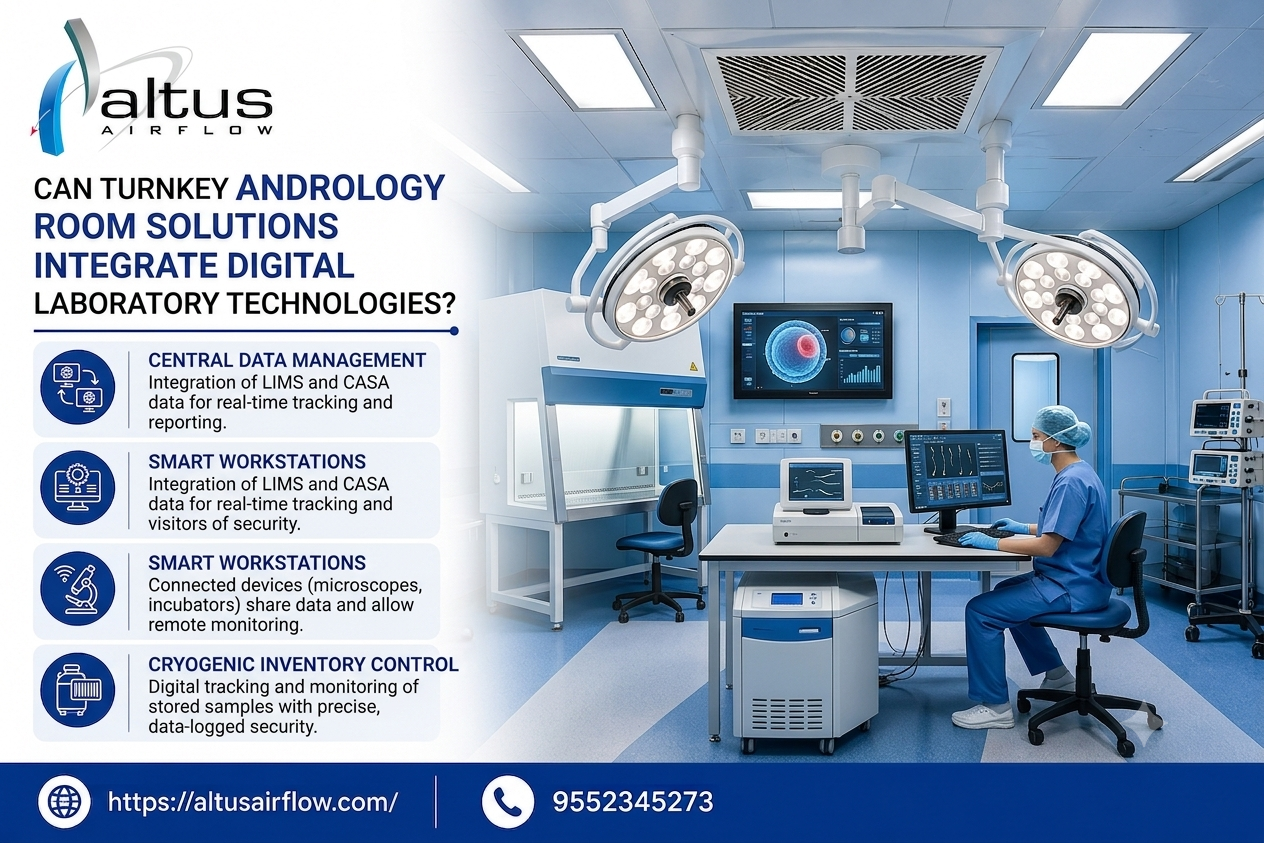
Altus Airflow understands that modern andrology laboratories require more than controlled physical environments. They also need reliable digital infrastructure to support laboratory workflows, monitoring, documentation, communication, and equipment management. Turnkey Andrology Room Solutions can integrate digital laboratory technologies by combining facility design with network connectivity, environmental monitoring, equipment interfaces, data systems, access control, alarms, and other digital infrastructure. Integrating these technologies during the design stage helps ensure that digital systems are properly positioned and coordinated with electrical, HVAC, and laboratory requirements.
Digital technology can improve how laboratory teams collect information, monitor environmental conditions, manage equipment, and maintain records. Temperature and humidity monitoring, digital dashboards, automated alerts, laboratory information systems, equipment connectivity, barcode systems, and secure data networks can all contribute to a more organized laboratory environment. However, successful integration depends on careful planning. The technology selected should match the laboratory's workflow, equipment, data-security requirements, and operational needs. A turnkey approach allows physical infrastructure and digital systems to be considered together, reducing compatibility issues and making future upgrades easier.
What Are Digital Laboratory Technologies?
Digital laboratory technologies include hardware, software, communication systems, sensors, monitoring platforms, and connected laboratory equipment used to support daily operations.
In an andrology laboratory, these technologies may be used for environmental monitoring, equipment tracking, sample identification, documentation, communication, data management, and quality-control activities.
Examples include digital temperature and humidity sensors, centralized monitoring dashboards, laboratory information systems, barcode or identification systems, connected incubators, equipment status monitoring, digital access control, automated alarms, data loggers, and network-connected laboratory instruments.
The exact technology mix depends on the laboratory's size, procedures, equipment, workflow, and quality requirements.
Can Turnkey Solutions Integrate Digital Technologies?
Yes, Turnkey Andrology Room Solutions can be designed to integrate digital laboratory technologies as part of the overall facility infrastructure. The integration can begin during the planning stage rather than being added after construction is complete.
During design, the project team can identify where sensors, data points, communication systems, display units, control panels, equipment connections, and network infrastructure will be required.
This approach allows digital systems to be coordinated with HVAC, electrical services, laboratory equipment, modular walls, ceilings, and furniture. Proper planning can also provide accessible pathways for cables and future technology upgrades.
Why Is Digital Integration Important in an Andrology Laboratory?
Andrology laboratories handle processes where environmental conditions, equipment performance, sample identification, and documentation can be important. Digital systems can help laboratory personnel monitor these areas more consistently.
For example, environmental sensors can continuously record temperature and humidity rather than relying only on manual readings. If a monitored parameter moves outside a predefined range, an alarm system may notify responsible personnel.
Digital records can also make it easier to review historical data and identify recurring deviations. However, digital monitoring should complement established laboratory procedures and quality systems rather than replace them.
How Does Environmental Monitoring Work?
Environmental monitoring is one of the most common digital technologies incorporated into modern laboratory infrastructure.
Sensors can monitor parameters such as temperature, humidity, pressure, airflow, and other conditions specified by the laboratory. Readings can be displayed on local screens or transmitted to a centralized monitoring platform.
A digital system can continuously collect measurements and store historical information. Authorized personnel can then review trends and investigate deviations.
The sensors should be installed at suitable locations and calibrated according to an appropriate schedule. Calibration records are important because inaccurate sensors can lead to incorrect environmental data.
Can Digital Systems Monitor HVAC Performance?
Yes. HVAC systems can be integrated with digital monitoring and control platforms to provide information about operating conditions.
Depending on the design, a monitoring system may display room temperature, humidity, pressure differential, airflow-related parameters, filter status, equipment operating status, and alarms.
Integration between HVAC controls and laboratory monitoring can help facility teams identify environmental deviations more quickly. It can also support preventive maintenance by providing information about system performance.
The monitoring architecture should be designed with appropriate access controls and alarm priorities so that important alerts are not overlooked.
How Can Laboratory Information Systems Be Integrated?
A Laboratory Information System (LIS) can support the management of laboratory data, records, samples, workflows, and reporting. In an andrology laboratory, LIS integration may depend on the procedures performed and the hospital's existing digital infrastructure.
The physical laboratory should provide suitable network connections, data points, workstations, and equipment interfaces where required.
The IT and laboratory teams should work together to define connectivity requirements before installation. This helps ensure that network infrastructure is adequate for current equipment and can support future additions.
Data integration should also consider user permissions, backups, cybersecurity, and institutional policies.
Can Laboratory Equipment Be Connected Digitally?
Many modern laboratory instruments provide digital communication capabilities. Depending on the equipment, connectivity may be provided through network connections, serial interfaces, USB connections, manufacturer-specific systems, or other communication protocols.
Connected equipment can potentially transfer information to centralized systems, reduce manual data entry, and support automated recordkeeping.
During room planning, equipment specifications should therefore be reviewed carefully. The required electrical outlets, network points, data connections, cable routes, and service clearances should be incorporated into the laboratory design.
How Do Barcode and Identification Systems Improve Workflow?
Barcode and digital identification systems can help organize sample and material tracking. Instead of relying entirely on handwritten labels, laboratories can use machine-readable identification linked to digital records.
The infrastructure may include barcode printers, scanners, workstations, network connections, and software integration.
The actual workflow should be mapped before installation so that scanners and workstations are positioned at practical locations. Poor placement can create unnecessary movement and reduce the benefits of the system.
Digital identification should also follow the laboratory's established procedures for sample handling, traceability, and data security.
How Do Automated Alerts Support Laboratory Operations?
Automated alerts can provide immediate notification when a monitored parameter moves outside a defined threshold.
For example, a monitoring platform may generate an alert if temperature or humidity exceeds the laboratory's specified range. Alerts can appear on a local display or be communicated through approved notification channels.
Alarm settings should be carefully configured to avoid excessive false alerts. Responsible personnel should also have clear procedures for responding to each type of alarm.
An alarm system is useful only when the laboratory has a defined response process, including investigation, corrective action, and documentation.
Can Digital Access Control Be Integrated?
Yes. Access control can be incorporated into the digital infrastructure of an andrology laboratory where required by the hospital or facility.
Electronic access systems can restrict entry to authorized personnel and maintain records of access activity. Depending on the facility, systems may use access cards, biometric identification, PINs, or other technologies.
Access-control planning should consider emergency access, privacy, equipment areas, staff circulation, and hospital security policies.
The system should also be coordinated with doors, electrical infrastructure, network connections, and emergency systems.
How Does Digital Technology Support Documentation?
Digital technology can simplify the collection and storage of laboratory records. Environmental readings, equipment status, maintenance information, calibration records, alarms, and other data may be stored electronically depending on the system.
Digital documentation can make historical records easier to retrieve and analyze. It can also help quality teams identify trends and investigate deviations.
However, electronic records should be protected through appropriate access controls, backups, data retention procedures, and cybersecurity measures.
What Role Does Network Infrastructure Play?
A reliable network is essential when multiple laboratory devices and monitoring systems need to communicate with centralized platforms.
Network planning should identify the number and location of data points, required bandwidth, equipment connectivity, server or cloud requirements, wireless coverage, and security controls.
Structured cabling can be routed through planned service pathways to keep the laboratory organized. Future spare capacity should also be considered where practical.
Network infrastructure should be coordinated with the hospital's IT team so that the laboratory follows institutional standards.
How Should Electrical Systems Be Planned for Digital Technologies?
Digital equipment requires reliable electrical power. Workstations, monitors, servers, sensors, network devices, laboratory instruments, displays, and control systems may all require electrical connections.
The electrical design should identify critical equipment and determine whether backup or emergency power is required. Suitable protection, earthing, cable management, and outlet positioning should also be considered.
Power requirements should be coordinated with the equipment manufacturer's specifications. This can help prevent overloaded circuits and inconvenient equipment connections.
Can Digital Monitoring Be Integrated With Building Management Systems?
Where supported by the facility's infrastructure, laboratory monitoring systems may communicate with a Building Management System (BMS).
This can allow selected environmental parameters and HVAC information to be viewed through a centralized platform. Facility managers may be able to monitor multiple rooms or departments from one interface.
The integration should be carefully defined because not every laboratory parameter or equipment system needs to be connected to the BMS. Critical alarms and data points should be identified during planning.
How Does Turnkey Planning Make Digital Integration Easier?
Turnkey Andrology Room Solutions provide an opportunity to coordinate physical and digital infrastructure within a single project framework.
The project team can review laboratory workflow, HVAC requirements, electrical services, network connectivity, equipment specifications, monitoring requirements, and room layout together.
This reduces the likelihood of installing digital equipment without adequate power, network connectivity, mounting space, or maintenance access. It can also simplify coordination between laboratory staff, IT teams, biomedical engineers, HVAC specialists, and contractors.
Planning digital infrastructure early is generally more efficient than trying to retrofit extensive systems after the laboratory has become operational.
What About Data Security and Privacy?
Digital laboratory technologies can generate sensitive operational and laboratory information. Therefore, data security should be considered from the beginning.
User authentication, role-based permissions, secure network connections, backups, software updates, audit trails, and appropriate data-retention procedures may be required depending on the system and institutional policies.
The laboratory's IT and compliance teams should determine the applicable cybersecurity requirements. Physical access to network equipment and control systems should also be appropriately managed.
Technology integration should improve efficiency without compromising information security.
How Are Digital Systems Tested Before Handover?
Digital systems should undergo appropriate testing before the laboratory becomes fully operational. Testing can confirm sensor readings, alarms, network connectivity, equipment communication, displays, access controls, and data recording functions.
Environmental sensors should be checked against calibrated reference instruments where applicable. Alarm conditions can be simulated to confirm that notifications reach the intended users.
Equipment interfaces should also be tested with the relevant software or hospital systems. Any identified issues should be corrected and retested before final handover.
Can Digital Technologies Support Future Upgrades?
Yes. A well-designed laboratory can include spare network points, accessible cable pathways, additional electrical capacity, and flexible mounting arrangements where practical.
Technology evolves rapidly, and new laboratory equipment may require different connectivity or monitoring capabilities in the future. Planning for reasonable expansion can reduce the disruption associated with later upgrades.
The infrastructure should therefore be designed with both current requirements and foreseeable future needs in mind.
How Does Maintenance Affect Digital Laboratory Performance?
Digital systems require ongoing maintenance just like physical laboratory infrastructure. Sensors may require calibration, network equipment may require updates, and monitoring software may need periodic maintenance.
HVAC monitoring systems should also be checked to ensure that environmental readings remain accurate. Backup power, alarm systems, access control, and communication interfaces should be tested according to the facility's maintenance program.
Maintenance records should be retained so that laboratory and facility teams can track system performance and identify recurring problems.
Choosing a Provider for Digital Andrology Room Integration
Hospitals and laboratories should evaluate whether the provider understands both controlled laboratory environments and digital infrastructure. Experience with HVAC, environmental monitoring, modular construction, electrical systems, networking, laboratory equipment integration, and commissioning can be valuable.
The project scope should clearly define which digital technologies are included, who supplies the equipment, who manages software integration, and who is responsible for testing and training.
It is also important to involve laboratory users, IT teams, biomedical engineers, facility managers, and quality personnel during planning. Their combined input can help ensure that the final system is practical, secure, maintainable, and aligned with operational needs.
Conclusion
Digital laboratory technologies can significantly enhance the organization, monitoring, documentation, and connectivity of a modern andrology laboratory. Environmental sensors, digital monitoring platforms, laboratory information systems, connected equipment, barcode systems, automated alerts, network infrastructure, and access control can all be incorporated when properly planned.
Altus Airflow can support the integration of physical laboratory infrastructure with digital requirements by coordinating HVAC, electrical systems, monitoring, modular construction, equipment interfaces, and other project components. Early planning helps ensure that digital systems have suitable power, connectivity, positioning, and maintenance access.
By working with Altus Airflow on an integrated project, laboratories can develop an infrastructure that supports current digital technologies while also allowing practical opportunities for future upgrades and technological expansion.
Frequently Asked Questions
1. Can Turnkey Andrology Room Solutions integrate digital laboratory technologies?
Yes, Turnkey Andrology Room Solutions can integrate environmental monitoring, laboratory information systems, connected equipment, network infrastructure, digital alerts, access control, and other technologies according to project requirements.
2. What digital systems can be used in an andrology laboratory?
Digital temperature and humidity monitoring, LIS connectivity, barcode systems, equipment interfaces, alarms, access control, and centralized dashboards are common examples.
3. Can HVAC systems be digitally monitored?
Yes. HVAC parameters such as temperature, humidity, pressure, airflow-related data, and equipment status can be monitored through suitable digital systems.
4. Is network infrastructure required for digital laboratory technology?
Yes. Network connectivity may be necessary for connected equipment, monitoring platforms, laboratory information systems, and centralized data management.
5. Are digital laboratory systems tested before handover?
Yes. Sensors, alarms, connectivity, equipment interfaces, access systems, and data-recording functions should undergo appropriate testing.
Read Our Previous Blog ---------------> Can a Modular Cardiac OT Engineering Company build hybrid cardiac operation theatres?
- Goth Lifestyle
- Fashion & Style
- Music & Bands
- Art & Photography
- Creative Writing & Poetry
- Events & Scene
- Occult & Spirituality
- DIY & Tutorials
- Beauty & Self-Care
- Relationships & Dating
- Gaming & Media
- Tech & Gadgets
- Body Art & Piercings
- Underground Culture
- Spotlights & Interviews
- Travel & Places
- Lifestyle & Daily Life
- Fitness & Health
- Travel & Adventure
- Books & Literature
- Tech & Gaming
- Movies & TV
- Food & Drinks
- Humor & Memes
- Pets & Animals
- General Arts & Crafts

 English
 Arabic
 French
 Spanish
 Portuguese
 Deutsch
 Turkish
 Dutch
Dutch
 Italiano
 Russian
 Portuguese (Brazil)
 Greek
Greek