


Ductless maintenance: what you do monthly and what a technician does yearly
Ductless maintenance: what you do monthly and what a technician does yearly
Ductless systems are marketed as low maintenance, and the outdoor half largely is. The indoor heads are not. They sit in the conditioned space with small filters and a permanently damp coil, and in a humid climate they need attention on a schedule most owners are never told about.
The monthly ten minutes
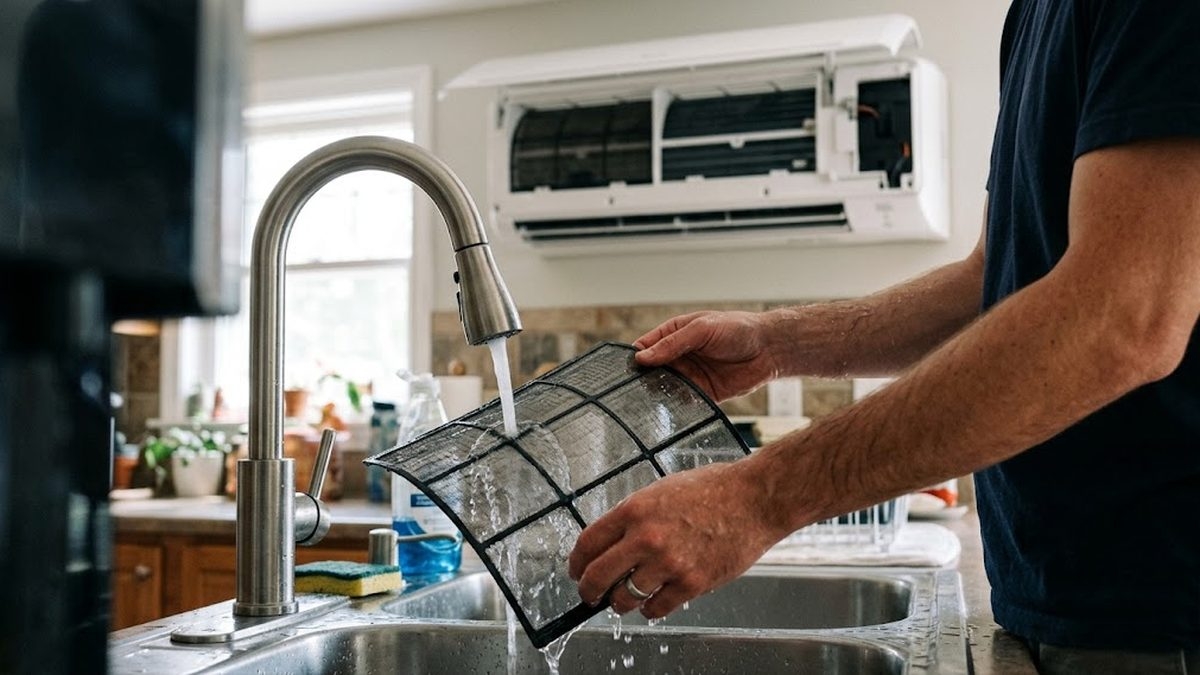
Rinse the filters. Lift the front cover, slide out the two mesh screens, rinse them under a tap from the clean side outward, shake them and let them dry completely before refitting. Never put a damp filter back into a head; you are installing a wet surface in a dark warm box. Monthly during cooling season is right here, not the quarterly interval printed in manuals written for milder climates.
Look at the discharge. Run each head for a few minutes and put a hand in the airflow. Weak air or air that is not cold is worth investigating before it becomes a complaint.
Watch the drain outlet. Find where the condensate line discharges outside and confirm water is actually coming out on a humid day. A dry outlet while the unit runs means the water is going somewhere else.
Walk past the outdoor unit. Clear leaves and clippings, keep vegetation back, check that nothing has been stacked against it. Ductless condensers are small and get treated as garden furniture.
Note anything new. A rattle, a smell in the first thirty seconds, a flashing light on the head. Written down with a date, these become useful; remembered vaguely, they do not.
Twice a year
Rinse the outdoor coil with the power off at the disconnect, working from the inside of the coil outward so debris leaves the way it came rather than being driven deeper. A garden hose at moderate pressure is right; a pressure washer bends fins permanently and is one of the more common ways owners damage their own equipment.
Check the line set insulation where it runs outside. Foam degrades in Florida sun, and any bare copper condenses water. Fresh UV-resistant tape or a proper line set cover restores it, and doing so in October costs nothing compared to finding a damp wall cavity later.
Confirm the outdoor unit is still level and secure on its pad or brackets. Pads settle, and a tilted condenser drains badly and vibrates.
What the annual professional visit involves
The centrepiece is a deep cleaning of each indoor head, which is a different operation from anything the owner can do. The technician removes the front casing, fits a bib or bag around the unit to catch runoff, and washes the coil and blower wheel with an appropriate cleaner. The blower wheel is the part that matters most: it accumulates a felt-like coating that reduces airflow and holds moisture, and it is completely inaccessible without disassembly.
The rest of the visit covers the drain pan and line, cleared and flushed rather than just inspected, condensate pump operation where one is fitted, electrical connections and amp draw, the outdoor coil cleaned properly rather than rinsed, and the system's operating data read from the control board. Inverter systems record a great deal of internal information, and reading it out is how a technician sees a problem that has not yet produced a symptom.
Ask for the head cleaning specifically when booking. Some maintenance agreements written around central systems do not include it, and a visit that skips it has skipped the item with the highest value on a ductless system.
| Task | Interval | Who |
|---|---|---|
| Rinse indoor filters | Monthly in cooling season | Owner |
| Check drain discharge | Monthly | Owner |
| Clear around outdoor unit | Monthly | Owner |
| Rinse outdoor coil | Twice a year | Owner or technician |
| Inspect line set insulation | Twice a year | Owner |
| Deep clean coil and blower wheel | Annually, more in kitchens | Technician |
| Flush drain and test pump | Annually | Technician |
| Electrical and operating data check | Annually | Technician |
Signs a head needs cleaning before the schedule says so
Annual is a default, not a rule, and several symptoms mean the interval is too long for that particular head.
Airflow has dropped. The most reliable indicator. A blower wheel coated with debris moves noticeably less air at the same fan setting, and because the change is gradual, the comparison that catches it is against another head in the house rather than against memory.
The smell arrives sooner and lasts longer. A brief mustiness in the first seconds is common. A smell that persists through the cycle means growth has spread beyond a patch on the coil.
It spits water. Droplets thrown from the outlet usually mean the blower wheel is loaded unevenly and flinging condensate rather than letting it drain, or that the coil is fouled enough for water to bridge across it. Either way the head is overdue.
Run times have lengthened. A fouled coil transfers heat poorly, so the head runs longer for the same result. On an inverter system this shows up as a unit that never seems to settle down to a low output.
Ice on the indoor coil. Restricted airflow across the coil drops its surface temperature below freezing. On a ductless head, that almost always means the filters, the coil or the wheel, and running it iced up achieves nothing.
Kitchen heads earn a shorter interval on principle. Cooking aerosols coat the wheel with a film that dust then sticks to, and a head above a hob can need cleaning twice as often as one in a bedroom.
Shortcuts that cause damage
Pressure washing the outdoor coil. Aluminium fins are thin and bend at pressures well below what a washer delivers. Bent fins restrict airflow permanently, and the damage is difficult to reverse.
Aerosol "no-rinse" coil cleaners on indoor heads. Sprayed through the front without removing the casing, the chemistry ends up on the blower wheel, in the drain pan and eventually on the floor, and it does not reach the parts that matter. Some formulations are corrosive to aluminium if not rinsed.
Bleach down the drain line. Bleach attacks metal components in the pan and the pump. Distilled vinegar or a purpose-made condensate treatment does the job without the collateral damage.
Running with the filters out. A head with no filters draws dust directly onto a wet coil, which is precisely how the coating on the blower wheel forms in the first place.
Ignoring an error code. Ductless heads report faults by flashing patterns or codes on the display, and the manufacturer's manual decodes them. Photographing the pattern and looking it up takes two minutes and sometimes resolves the issue without a call.
Systems that sit idle
Seasonal use creates its own problem. A head that has not run for months has a coil that dried out with whatever was on it, and the first start-up of the season releases that into the room. A garage or guest room head used a few weekends a year often ends up in worse condition than one running daily.
Two habits help. Run each head for an hour every few weeks even out of season, which keeps the coil cycling wet and dry rather than sitting still. And schedule the professional cleaning for the start of the season rather than the end, so the deep clean is followed by use instead of by months of stagnation.
For a house left empty over the summer, set at least one zone to hold around 78 to 80 °F rather than switching everything off. The cost is modest and it keeps the building's humidity in a range where mould is not the outcome. How that fits with the rest of a ductless system's care is covered in more on ductless systems.
What neglect actually costs
The progression is consistent. Dirty filters restrict airflow. Restricted airflow means less air across the coil, which means the coil runs colder and the head's capacity falls. Lower capacity means longer run times for the same result, which shows up on the bill. Meanwhile the damp, dust-loaded blower wheel becomes a smell, and a smell is what finally prompts the call.
By then the cheap intervention has been missed. A rinse costs nothing. A professional head cleaning costs a modest service fee. Replacing a blower motor because the wheel has been running out of balance, or replacing a head because a drain overflowed into the wall behind it, are different orders of expense entirely.
Frequently asked questions
Can I clean the blower wheel myself?
It is possible and it is fiddly. The wheel is behind the coil, the electronics are immediately adjacent, and heads are easily damaged during removal and refitting. Most people are better served paying for it once a year, though rinsing filters and keeping the outdoor coil clear are entirely reasonable to do yourself.
How often do the filters really need rinsing in Florida?
Monthly through cooling season. Homes with pets, heavy cooking or construction nearby need it more often. The filters are washable, so the only cost is the ten minutes.
Does a ductless system need a refrigerant top-up periodically?
No. A sealed system does not consume refrigerant. If the charge is low, there is a leak, and adding refrigerant without finding it is treating a symptom.
The head smells musty only when it starts. Is that dangerous?
It indicates biological growth on the coil or blower wheel, which is a nuisance for most people and a genuine problem for anyone with asthma or an allergy. It is resolved by a proper cleaning, and it will return on a predictable schedule if the underlying humidity and filter routine do not change.
Current as of September 2026.
- Goth Lifestyle
- Fashion & Style
- Music & Bands
- Art & Photography
- Creative Writing & Poetry
- Events & Scene
- Occult & Spirituality
- DIY & Tutorials
- Beauty & Self-Care
- Relationships & Dating
- Gaming & Media
- Tech & Gadgets
- Body Art & Piercings
- Underground Culture
- Spotlights & Interviews
- Travel & Places
- Lifestyle & Daily Life
- Fitness & Health
- Travel & Adventure
- Books & Literature
- Tech & Gaming
- Movies & TV
- Food & Drinks
- Humor & Memes
- Pets & Animals
- General Arts & Crafts

 English
 Arabic
 French
 Spanish
 Deutsch
 Turkish
 Dutch
Dutch
 Italiano
 Russian
 Romaian
 Portuguese (Brazil)
 Greek
Greek