


Understanding Sieves: Types, Uses, Applications, and Accurate Particle Size Separation
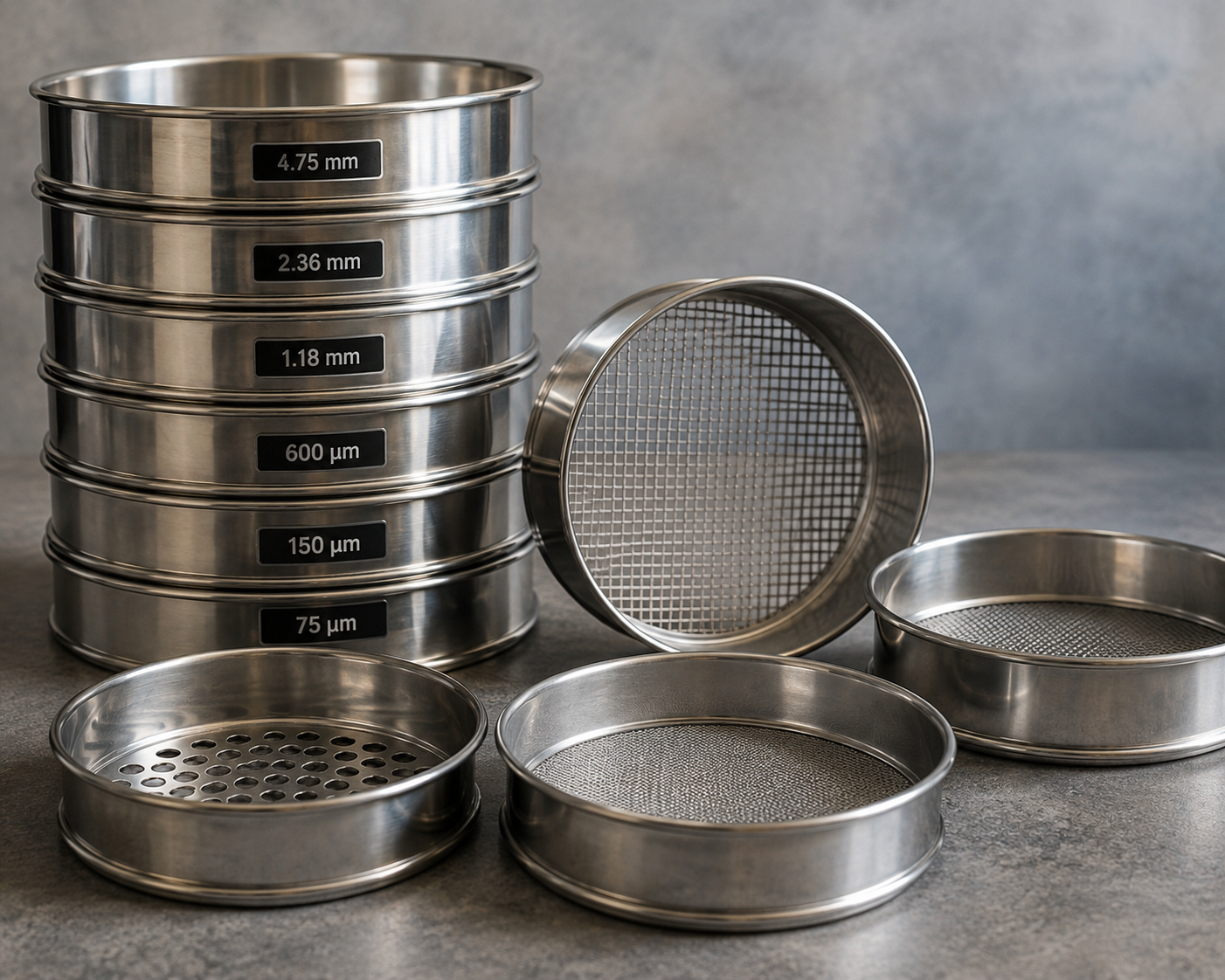
Sieves and Their Role in Accurate Material Separation
Understanding the Purpose of Sieving
Sieving is one of the most practical methods used to separate materials according to particle size. It is widely applied in laboratories, manufacturing facilities, construction testing, food processing, pharmaceuticals, agriculture, mining, and many other fields where particle size affects product quality or process performance. The basic principle is simple. A material is placed on a screen containing openings of a defined size, and particles smaller than those openings pass through while larger particles remain above the screen.
Although the principle is straightforward, accurate sieving requires careful selection of equipment, correct handling of samples, and consistent testing procedures. The results can provide valuable information about the distribution of particles within a material. This information may be used to determine whether a material meets a required specification, identify changes in production, control raw material quality, or improve the performance of a finished product.
The design and construction of sieves can vary depending on the material being tested and the purpose of the examination. A sieve normally consists of a frame and a screening surface containing openings of a known size. The screening surface may be manufactured from woven wire, perforated metal, or another suitable material. Different opening sizes allow several sieves to be arranged together so that a sample can be separated into multiple particle size ranges.
How Sieving Works
The sieving process relies on the movement of particles across a screening surface. When a sample is placed onto the screen and subjected to controlled movement, particles smaller than the openings can pass through them. Larger particles remain on the surface. The movement may be produced manually or through mechanical equipment that provides a controlled shaking or vibrating action.
The effectiveness of separation depends on several factors. Particle size is obviously important, but particle shape, moisture content, density, surface texture, and the tendency of particles to stick together can also influence the result. A dry granular material usually behaves differently from a damp or sticky material.
For laboratory testing, a sample is generally weighed before the test begins. If several screening surfaces are required, they are arranged from the largest opening at the top to the smallest opening at the bottom. A collection pan is placed beneath the smallest opening. The sample is then introduced into the uppermost screen and subjected to a defined period of movement.
After the screening process, the material retained on each screen is collected and weighed. The mass retained at each size level can then be converted into a percentage of the original sample. This produces a particle size distribution that shows how much material falls within each size range.
Types of Sieves
Different applications require different sieve designs. Woven wire sieves are among the most commonly used because they provide consistent openings and are suitable for a wide range of dry granular materials. They are frequently used in laboratories for particle size analysis.
Perforated plate sieves use a metal sheet containing regularly arranged openings. They can provide greater structural strength and may be useful for larger or heavier particles. The shape of the openings can also be selected according to the characteristics of the material.
Specialized screening equipment may include fine mesh screens designed for very small particles. Other designs are intended for coarse materials that require larger and stronger openings. The choice depends on the material, expected particle size, testing method, and required accuracy.
Laboratory sieves are generally manufactured in standardized dimensions so they can be used with compatible testing equipment. Standardization makes it easier to compare results between different tests and facilities.
Selecting the Correct Sieve Size
Choosing the appropriate opening size is an important part of particle analysis. If the selected sizes are unsuitable, the test may not provide enough information about the material.
When a broad range of particle sizes is expected, several screening levels can be used. The largest opening is placed at the top, followed by progressively smaller openings. This arrangement allows the material to be divided into several fractions.
For a material with a narrow particle size range, fewer screening levels may be required. The selection should be based on the purpose of the test rather than simply using every available size.
The condition of the sample should also be considered. If particles are likely to clump together, drying or another preparation method may be necessary before screening. However, sample preparation should always follow the requirements of the applicable testing procedure because excessive drying or handling can alter certain materials.
Importance of Sample Preparation
Sample preparation has a direct effect on the reliability of a sieving result. A representative sample must be selected from the larger quantity of material. If the sample does not accurately represent the whole batch, the final particle distribution may be misleading.
The sample should be handled carefully to prevent contamination or accidental loss. Foreign material can alter the measured distribution, while loss of fine particles during transfer can produce an incorrect result.
Moisture is another important consideration. Water can cause particles to stick together, preventing smaller particles from passing through the openings. Some materials may therefore require controlled drying before testing. Other materials may need to be tested in their natural condition, depending on the purpose of the analysis.
The quantity of sample also matters. Too little material may not provide a representative result, while an excessive amount can overload the screening surface and prevent particles from moving freely. The appropriate sample quantity should therefore be selected according to the material and testing method.
Manual and Mechanical Sieving
Manual sieving can be suitable for small samples and simple examinations. The operator moves the sieve in a controlled manner for a specified period. This approach is inexpensive and requires limited equipment, but the result can depend on the technique of the person performing the test.
Mechanical sieving provides more consistent movement and is commonly used when repeated testing is required. A mechanical shaker can apply controlled vibration or oscillation to the stack of screening surfaces. This reduces variation caused by differences in manual handling.
Mechanical equipment should be inspected regularly to ensure that the movement remains consistent. Excessive vibration, insufficient movement, or incorrect operating settings can affect particle separation.
Regardless of the method, the screening process should continue for an appropriate period. If the process is stopped too early, particles may not have enough opportunity to pass through the correct openings. Excessive screening can also create problems with certain fragile materials if the particles break during testing.
Factors That Affect Sieving Accuracy
Several factors can influence the quality of a particle size analysis. One of the most common is particle shape. Round particles tend to pass through openings more easily than flat, elongated, or irregular particles.
Particle moisture can also affect movement. Damp particles may stick together or adhere to the screening surface. Static electricity can cause fine particles to cling to surfaces, especially in dry environments.
The condition of the screening surface is equally important. Damaged, blocked, stretched, or contaminated openings can produce incorrect results. A screen should therefore be inspected before and after use.
Sample loading is another important factor. If too much material is placed on a screening surface, particles may form layers that prevent smaller particles from reaching the openings. Using a suitable sample quantity helps maintain efficient separation.
The duration and intensity of movement should remain consistent between tests. Changes in these conditions can make it difficult to compare results from different samples.
Cleaning and Maintaining Sieves
Proper maintenance helps preserve the accuracy and service life of screening equipment. After each test, retained material should be removed carefully. Fine particles can become trapped within openings and may affect subsequent tests.
Cleaning methods should be selected according to the construction and material of the screen. Gentle brushing may be suitable for some surfaces, while other applications may require controlled washing or specialized cleaning procedures.
Sharp objects should not normally be used to force particles through blocked openings because they can damage the screening surface. Even small changes to opening dimensions can influence the result.
After cleaning, the equipment should be allowed to dry completely when moisture has been introduced. Screens should also be stored in a clean environment where they are protected from unnecessary physical damage.
Regular inspection can identify stretched wire, broken wires, corrosion, damaged frames, blocked openings, and other problems before they affect testing.
Applications in Construction
Particle size analysis is particularly important in construction materials. Aggregates used in concrete, asphalt, drainage systems, and other applications must often meet specific size requirements.
The distribution of aggregate particles affects properties such as workability, packing, void content, permeability, and strength. A suitable combination of particle sizes can allow smaller particles to occupy spaces between larger particles, improving the overall arrangement of the material.
In soil testing, sieving can help determine the proportion of coarse particles within a sample. This information contributes to soil classification and can assist engineers in understanding drainage and compaction characteristics.
Construction laboratories commonly use standardized screening procedures so that material quality can be assessed consistently. Accurate equipment and careful sample preparation are essential for obtaining meaningful results.
Applications in Food Processing
Food manufacturers use particle size analysis to monitor ingredients and finished products. Flour, sugar, spices, grains, powdered ingredients, and other materials may need to meet particular particle size requirements.
Particle size can affect texture, appearance, mixing behavior, dissolution, and processing efficiency. For example, a powder containing too many coarse particles may behave differently during mixing or cooking than a more uniformly sized powder.
Screening can also help identify unwanted oversized particles or foreign material. Regular testing provides useful information about changes in raw materials and production processes.
Because food materials may be sensitive to moisture, cleaning and sample handling should be performed carefully to prevent contamination and preserve the quality of the test.
Applications in Pharmaceutical Manufacturing
Particle size is an important characteristic in pharmaceutical production because it can influence the behavior of powders and other solid materials. It may affect mixing, flow, dissolution, and the uniformity of formulations.
Screening can be used as one method of evaluating particle size, although the most suitable analytical technique depends on the characteristics of the material and the required measurement range.
Strict cleanliness is especially important in pharmaceutical environments. Equipment must be maintained according to established procedures, and testing conditions should be controlled to prevent contamination.
Accurate records should also be maintained so that results can be reviewed and compared over time. Consistent procedures help identify changes that may indicate problems with raw materials or production conditions.
Applications in Mining and Mineral Processing
Mining and mineral processing operations handle materials containing a wide range of particle sizes. Screening helps separate crushed material into useful size categories and supports the efficient operation of downstream processes.
Particle size influences how materials behave during crushing, grinding, separation, transportation, and processing. Oversized material may require additional treatment, while properly sized material can proceed to the next stage.
Laboratory screening can also be used to evaluate the performance of crushing and grinding equipment. Comparing particle distributions before and after processing can show whether a process is producing the intended result.
For large scale industrial operations, screening systems may use substantial equipment designed to handle continuous material flow. The same basic principle remains the separation of particles according to their ability to pass through defined openings.
Recording and Interpreting Results
A useful sieving test should produce clear and traceable records. Important information can include the sample identification, original sample mass, screening sizes, retained mass, test duration, equipment used, and testing conditions.
The mass retained on each screening level is normally expressed as a percentage of the original sample. These percentages can be added progressively to determine cumulative retained material. The percentage passing each opening can then be calculated.
The resulting information can be presented as a particle size distribution. This allows technicians and engineers to understand whether a material contains mostly fine, medium, or coarse particles.
When results from several samples are compared, differences in particle distribution may reveal changes in raw materials or processing conditions. A sudden change may justify further investigation into equipment settings, material properties, or sample preparation.
Common Problems During Sieving
Several problems can reduce the reliability of screening results. One common issue is screen blockage. Fine particles can occupy openings and prevent other particles from passing through.
Another problem occurs when particles form clusters. This is especially common when moisture is present. If individual particles remain attached to one another, the test may classify them as larger particles than they actually are.
Overloading the screening surface can also reduce separation efficiency. When material is spread too thickly, smaller particles may not reach the openings.
Damaged screens can create another source of error. Broken or distorted openings may allow particles of an incorrect size to pass through.
Poor sample handling can result in material loss. Fine particles are particularly vulnerable to loss during transfer because they can remain on containers, equipment surfaces, or surrounding areas.
Improving Testing Consistency
Consistency begins with a clearly defined procedure. The same sample preparation method, sample quantity, screening arrangement, movement conditions, and evaluation process should be used whenever comparable results are required.
Operators should inspect equipment before testing and verify that the screening surfaces are clean and undamaged. Samples should be weighed accurately, and material should be transferred carefully.
Where mechanical equipment is used, operating conditions should remain stable. Regular equipment checks can help identify changes in movement that could affect results.
Training is also important. Personnel should understand why each step is performed rather than simply following instructions without understanding their purpose. This helps reduce avoidable errors and improves the quality of recorded data.
Safety Considerations
Although sieving is generally a straightforward procedure, appropriate safety measures are still necessary. Operators should consider the characteristics of the material being tested, especially when working with dust, chemicals, sharp particles, or potentially harmful substances.
Dust generating materials may require suitable ventilation and protective equipment. Samples should be handled according to the safety requirements of the workplace.
Mechanical screening equipment should be operated with appropriate guards and according to manufacturer instructions. Loose clothing and other items that could become caught in moving equipment should be kept away from operating machinery.
Cleaning procedures should also be performed safely. The correct method depends on the material and equipment involved.
Final Considerations
Sieving remains an important method for understanding particle size and material composition. Its value comes from its simplicity, repeatability, and ability to provide practical information across many industries.
Reliable results depend on more than the screening surface itself. Sample selection, moisture control, equipment condition, screening time, loading quantity, cleaning, and accurate recording all contribute to the quality of the final measurement.
When these factors are controlled carefully, particle size analysis can help identify material variations, support quality control, improve production processes, and verify compliance with required specifications. Whether used in a small laboratory or a large industrial operation, a properly performed sieving process provides useful information for making informed decisions about material quality and performance.
- Goth Lifestyle
- Fashion & Style
- Music & Bands
- Art & Photography
- Creative Writing & Poetry
- Events & Scene
- Occult & Spirituality
- DIY & Tutorials
- Beauty & Self-Care
- Relationships & Dating
- Gaming & Media
- Tech & Gadgets
- Body Art & Piercings
- Underground Culture
- Spotlights & Interviews
- Travel & Places
- Lifestyle & Daily Life
- Fitness & Health
- Travel & Adventure
- Books & Literature
- Tech & Gaming
- Movies & TV
- Food & Drinks
- Humor & Memes
- Pets & Animals
- General Arts & Crafts

 English
 Arabic
 French
 Spanish
 Deutsch
 Turkish
 Dutch
Dutch
 Italiano
 Russian
 Romaian
 Portuguese (Brazil)
 Greek
Greek