


Expansion Bellows Manufacturer Insights: Trends and Innovations In 2026
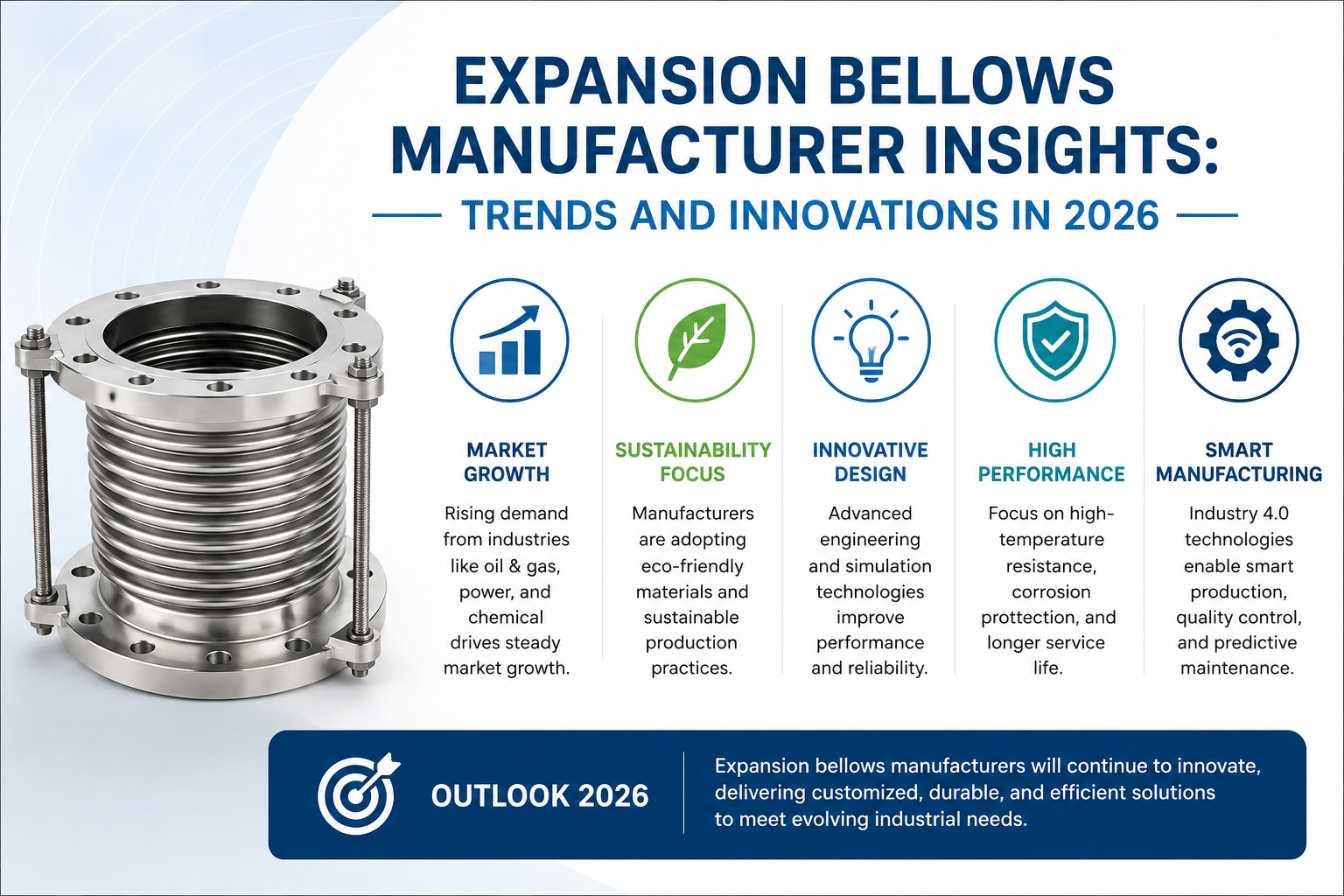
Introduction
The expansion bellows market does not move fast. The product category is governed by a design standard — EJMA — whose ninth edition contains calculation methods refined over decades, and the materials that dominate production, 316L austenitic stainless and grade 321 titanium-stabilised stainless, have been the standard choices for thirty years. A fabrication technology that has worked reliably across power generation, petrochemical, and district heating infrastructure is not going to be disrupted by a new alloy or a new welding process in a single product cycle.
What does change, and what is changing in 2026, is the context around the product: the application demands placed on it by hydrogen infrastructure, floating offshore energy, and data centre cooling at densities that existing pipe routing cannot absorb without flexible joints; the procurement and qualification requirements imposed by project finance lenders and EPC contractors running supply chain risk management programmes that have become considerably more rigorous since 2020; and the simulation and documentation infrastructure that an expansion bellows manufacturer must now demonstrate capability in to remain credible in the upper tier of the market. Those changes are worth examining for what they reveal about where the product category is heading and where the gaps between current manufacturing practice and emerging application requirements are opening.
Hydrogen Infrastructure and What It Demands That Steam Service Did Not
The global pivot toward hydrogen as an energy carrier — green hydrogen from electrolysis, blue hydrogen from steam methane reforming with carbon capture, and the repurposing of existing natural gas infrastructure for hydrogen blending — is creating a service environment for expansion joints that is materially different from the steam and hydrocarbon services that drove most of the product category's development history.
Hydrogen embrittlement is the engineering constraint that changes the material selection conversation. Austenitic stainless steel in the solution-annealed condition is generally considered resistant to hydrogen embrittlement at ambient temperature, but under high-pressure gaseous hydrogen — above 100 bar at ambient temperature, which is the operating range of hydrogen compression and storage infrastructure — even austenitic alloys show reduced fracture toughness and fatigue crack growth rate acceleration compared to inert gas service at the same stress level. The ASME B31.12 hydrogen piping code and its companion material qualification standard ASTM A370 require that materials intended for high-pressure hydrogen service demonstrate adequate toughness under the specific hydrogen exposure conditions of the application, which for a bellows element means testing in hydrogen-charged condition rather than in air.
The bellows element's unique geometry — thin ply, high surface area, cyclic stress at the convolution root — creates a hydrogen exposure scenario more aggressive than a thick-walled pipe in the same service. Hydrogen permeates into the metal surface faster relative to section thickness in a 0.5 mm ply than in a 20 mm pipe wall, and the cyclic bending stress at the convolution root during movement cycles creates the sustained tensile stress at a crack tip that hydrogen embrittlement requires to accelerate fatigue crack propagation. An expansion bellows manufacturer qualifying product for high-pressure hydrogen service in 2026 needs materials tested in hydrogen, weld procedure qualifications that account for the hydrogen exposure of the weld heat-affected zone, and fatigue life data from hydrogen-charged specimens — a qualification package that very few manufacturers had assembled before hydrogen infrastructure became a credible procurement reality.
Floating Offshore Wind and the Multi-Axis Movement Problem
Fixed offshore wind installations use expansion joints in platform piping for the same reasons as onshore plant — thermal growth in heated process lines, pump vibration isolation, misalignment compensation at equipment connections. The loads are predictable and the movement is primarily axial or lateral with small angular components that a conventional single bellows or universal joint design handles without difficulty.
Floating offshore wind platforms — semi-submersible and spar buoy designs — are a different design problem. The platform itself moves: it pitches, rolls, and yaws with wave action at amplitudes that depend on the mooring system design and the sea state, and any rigid piping connecting the platform to fixed infrastructure must accommodate the platform's six degrees of freedom movement simultaneously with the thermal expansion of the pipe. That simultaneous multi-axis movement exceeds what a single expansion joint design handles by design, and the compound joint arrangements that accommodate it — typically a sequence of hinged or gimbal joints arranged to convert platform motion into pure rotation at each joint — must be sized and oriented through a dynamic analysis of the platform's motion spectrum rather than the static thermal expansion calculation that onshore pipe stress analysis uses.
The expansion bellows manufacturer who supplies to floating offshore wind in 2026 is not simply applying existing product in a new location. The design calculation requires platform motion data from the mooring analysis, the bellows element must withstand not just the thermal cycle but the dynamic fatigue of wave-frequency displacement cycles at frequencies around 0.05–0.2 Hz with superimposed wind-frequency cycles at 0.1–1.0 Hz, and the materials must resist seawater corrosion on external surfaces that are continuously spray-wetted. Super duplex stainless 2507 (UNS S32750), with PREN above 42 and yield strength of 550 MPa minimum, is the material direction that offshore specifications are pushing the bellows element toward — a material that most manufacturers can source but few have qualified welding procedures for in thin-ply bellows section thickness.
Data Centre Cooling: Density, Leakage, And the Zero-Downtime Requirement
Data centre cooling infrastructure has changed faster than almost any other application area that expansion joints serve. A hyperscale data centre in 2022 was designed around server rack densities of 10–20 kW per rack. In 2026, GPU-dense AI compute facilities are specifying 50–100 kW per rack, with some direct liquid cooling architectures exceeding 100 kW per rack — heat loads that air-cooled infrastructure cannot dissipate at acceptable cooling energy consumption and that have driven adoption of direct liquid cooling to the chip level, rear-door heat exchangers, and immersion cooling systems that create dense fluid distribution networks in environments where a pipe joint leak causes immediate equipment damage and unplanned downtime.
The expansion joint requirements in data centre cooling infrastructure flow from this zero-leak-tolerance context. A standard industrial installation accepts that a sight glass has a finite probability of weeping under a thermal transient and that the maintenance team will address it on the next inspection round. A data centre liquid cooling distribution manifold serving active GPU clusters operates under a service requirement closer to semiconductor process tooling — zero tolerated leakage events, planned maintenance only at scheduled downtime windows that may occur quarterly, and documentation that supports the facility's uptime guarantee to its hyperscale tenants.
An expansion bellows manufacturer qualifying product for data centre cooling service in 2026 needs to demonstrate leak tightness at a level that standard hydrostatic testing does not confirm. Helium leak testing to mass spectrometer sensitivity — typically at a minimum detectable leak rate of 1×10⁻⁶ to 1×10⁻⁸ Pa·m³/s depending on the specification tier — provides the assurance that hydrostatic testing, with its minimum detectable leak rate of approximately 10⁻³ Pa·m³/s, does not. That testing requirement, combined with non-ferrous compatibility requirements for cooling fluid contact surfaces in some immersion cooling architectures, is building a data centre cooling specification tier within the expansion joint market that did not meaningfully exist five years ago.
Digital Twin Integration and What It Changes About Design Validation
The finite element analysis software that an expansion bellows manufacturer uses to simulate bellows performance — ANSYS, ABAQUS, and purpose-built forming simulation tools like DEFORM for the hydroforming manufacturing step — has been in use for decades. What is changing in 2026 is how that simulation capability connects to the customer's own digital environment and what that connection enables during the product's service life, not just its design phase.
A digital twin of an installed expansion joint — parameterised by the joint's specific geometry, material properties, installation configuration, and operating conditions — connected to in-line condition monitoring data (pressure, temperature, and displacement if the joint carries sensors) can track fatigue cycle accumulation against the EJMA predicted life in near-real time. When the accumulated cycle count at the monitored operating conditions approaches a defined fraction of the calculated fatigue life, the digital twin generates a replacement recommendation before the bellows reaches the failure condition rather than at an arbitrary calendar maintenance interval. This predictive replacement model is what asset management programmes in power generation, LNG, and process industry are pushing their critical piping component suppliers toward, and an expansion bellows manufacturer who can provide a digital product model that integrates with the customer's plant information management system is differentiated from one who delivers a paper datasheet with the shipment.
The global metal bellows market enters 2026 with more disciplined procurement behaviour and a more regionally diversified supply architecture, which at the application engineering level translates to customers qualifying multiple sources for critical expansion joint programmes and demanding digital design files — not just drawings — as part of the approved supplier package. A 3D model of the expansion joint that feeds directly into the customer's piping stress analysis software eliminates the geometry translation step that previously required manual re-entry of joint dimensions and stiffness parameters, and the manufacturers who provide this seamlessly are reducing a non-value-added engineering task that the customer was previously paying for in engineering hours.
Inorganic Binder Systems and Welding Technology Evolution
The manufacturing process for metallic expansion bellows has two steps that constrain quality most directly: the hydroforming or mechanical rolling step that forms the convolution geometry from flat tube, and the orbital or plasma TIG welding step that joins ply layers, forms the longitudinal seam on rolled bellows, and attaches the end hardware. Both are undergoing incremental but meaningful evolution in 2026.
Hydroforming tool control has moved toward closed-loop pressure-displacement feedback in new installations, where the forming pressure profile is adjusted in real time based on the measured displacement of the convolution being formed, rather than following a fixed pressure-time programme. The consequence is that convolution geometry — pitch, height, root radius — varies less between the first convolution and the last on a long bellows element, because the closed-loop system compensates for the material's work-hardening as the forming sequence progresses. Wall thickness distribution through the convolution, measured at CT8 tolerance-equivalent precision in advanced quality programmes, shows 8–12% improvement in uniformity coefficient compared to open-loop forming at equivalent forming pressures — a manufacturing process refinement that translates directly into more consistent fatigue life across the convolution set.
Orbital TIG welding of thin-ply bellows, particularly for seam welds on longitudinally welded bellows above DN400 where the ply thickness runs 0.8–1.5 mm, now incorporates active arc length control using laser triangulation of the weld pool surface to maintain consistent heat input per unit length as the torch traverses the seam. Variable heat input on thin-ply welding is the primary source of weld crown height variation and HAZ width scatter — both of which affect the fatigue stress concentration at the weld toe and hence the fatigue life of the finished bellows element. An expansion bellows manufacturer with active arc length control as standard equipment on thin-ply orbital welding is producing HAZ geometry that is controlled by measurement, not by parameter setting, and the difference shows in fatigue test scatter data from type test programmes where consistent weld geometry produces consistent fatigue life rather than a scatter band that forces a conservative knock-down factor on the calculated life.
Supply Chain Localisation and What the Post-2020 Procurement Environment Changed
The global Metal Bellows Expansion Joints market was valued at approximately USD 918 million in 2025 and is projected to reach USD 1,314 million by 2034 at a CAGR of 5.3%, driven by infrastructure investment and growing demand for thermal expansion management. That growth is not distributing evenly across the established supplier geography. The supply chain disruptions of 2020–2022 — shipping capacity constraints, port congestion, and component shortages that pushed equipment delivery lead times across multiple industries to levels that EPC project scheduling could not absorb — produced a lasting change in how project procurement teams assess supply chain risk.
Long-lead expansion joints procured from a single European or North American source on 20–30 week lead times are now evaluated against dual-source programmes that include a qualified domestic or regional manufacturer capable of 8–14 week delivery on the same specification. The qualification cost of a second source — engineering review, sample testing, PPAP-equivalent documentation for the project — is now routinely included in the project budget as a risk mitigation expenditure rather than treated as optional. For Indian infrastructure projects, this shift has accelerated qualification of domestic expansion bellows manufacturer operations that can meet the same EJMA design basis, material certification, and pressure test documentation as the import alternative at meaningfully shorter delivery lead times.
Yogiraj Engineering Company, an ISO 9001:2015 certified manufacturer based at GIDC Vithal Udyognagar, Anand, Gujarat, producing expansion bellows and piping products across metallic and non-metallic configurations for chemical, pharmaceutical, power generation, water treatment, and industrial process applications, represents the expansion bellows manufacturer tier that this supply chain localisation trend is activating — domestic producers whose quality management systems, engineering documentation capability, and product range now satisfy the dual-source qualification criteria that infrastructure project procurement teams are applying with increasing frequency to their critical piping component supply chains.
Conclusion
The trends shaping expansion bellows manufacturer practice in 2026 are not primarily about the bellows itself changing. The convolution geometry, the EJMA design basis, and the stainless steel alloy families that have dominated the product for decades remain central. What is changing is the service environment the bellows is being asked to operate in — hydrogen at 200 bar, floating platforms in six-degree-of-freedom motion, data centre cooling at zero-leak-tolerance — and the procurement and documentation environment the manufacturer must operate within, where digital product models, dual-source qualification, and predictive maintenance integration are becoming baseline expectations rather than differentiating features.
Manufacturers who are developing capability in these directions in 2026 are not chasing a technology trend. They are responding to application requirements that are already inside project specifications, already in qualification discussions with engineering contractors, and already determining which expansion bellows manufacturer operations remain in the shortlist when the purchase order is placed.
- Goth Lifestyle
- Fashion & Style
- Music & Bands
- Art & Photography
- Creative Writing & Poetry
- Events & Scene
- Occult & Spirituality
- DIY & Tutorials
- Beauty & Self-Care
- Relationships & Dating
- Gaming & Media
- Tech & Gadgets
- Body Art & Piercings
- Underground Culture
- Spotlights & Interviews
- Travel & Places
- Lifestyle & Daily Life
- Fitness & Health
- Travel & Adventure
- Books & Literature
- Tech & Gaming
- Movies & TV
- Food & Drinks
- Humor & Memes
- Pets & Animals
- General Arts & Crafts
 English
 Arabic
 French
 Spanish
 Portuguese
 Deutsch
 Turkish
 Dutch
Dutch
 Italiano
 Russian
 Romaian
 Portuguese (Brazil)
 Greek
Greek