


Why Rooftop Solar Systems Are Becoming a Standard Feature in Modern Homes
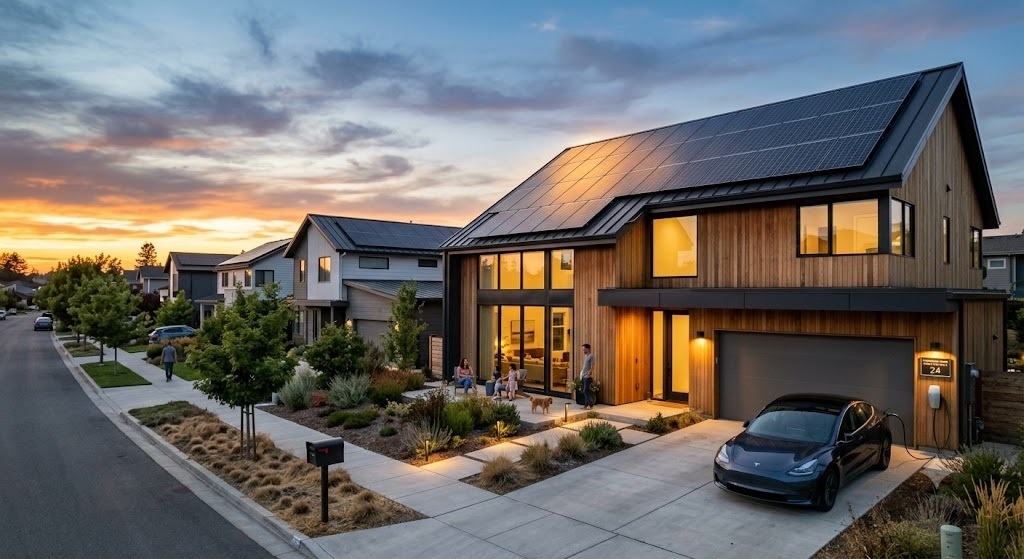
A decade ago, a house with solar panels on its roof was a statement — a visible signal that the owner had made a deliberate, somewhat unusual investment ahead of the mainstream. That framing no longer holds. In new residential construction and in retrofit markets across most Indian cities, a Rooftop Solar System for Home has moved from an optional upgrade discussed alongside premium flooring or smart-home wiring to a default line item evaluated on the same basis as the water heater or the inverter backup — not because environmental sentiment has shifted, though it has, but because the underlying cost and reliability arithmetic has crossed a threshold that makes the alternative, continued full dependence on grid supply, the harder position to justify.
The shift is measurable rather than anecdotal. Panel costs per watt have fallen by roughly 75--80% over the past decade, residential-scale inverter and battery technology has matured to the point where a mid-sized home installation is a standardised product rather than a custom engineering exercise, and grid tariffs for residential consumers have moved upward at a compounding 4--7% annually across most states, a trajectory that shows no structural reason to reverse. Set against a monthly electricity bill that keeps climbing regardless of consumption discipline, a Rooftop Solar System for Home converts a recurring, uncontrollable operating cost into a largely fixed capital cost with a defined payback period, which is the single financial characteristic most responsible for its shift from niche to standard.
This piece works through the specific factors driving that shift, the technical and financial mechanics that make the case for a typical home, and what property owners evaluating the decision should actually be looking at beyond sticker price.
Rising Tariffs and the Compounding Cost of Standing Still
Residential electricity tariffs across most Indian states have followed a consistent upward trajectory over the past several years, with periodic tariff revisions driven by DISCOM revenue requirements, fuel cost adjustments, and cross-subsidy restructuring that has, in several states, specifically increased rates for higher-consumption residential slabs — the exact consumption bracket occupied by homes with air conditioning, electric water heating, and the general appliance load of a modern household. A household paying ₹8 per unit today, at a conservative 5% annual tariff escalation, is paying roughly ₹13 per unit in fifteen years for the identical consumption pattern, with no corresponding increase in what that electricity delivers.
A Rooftop Solar System for Home does not merely offset current consumption at current rates. It fixes a large share of the household's future electricity cost at the system's installed cost, amortised over a 25-year panel warranty period, which means the value of the system increases in real terms every time the DISCOM revises tariffs upward — a dynamic that a household evaluating solar purely on today's payback period, without modelling tariff escalation, systematically understates.
Falling System Costs and the Efficiency Curve
The cost side of the equation has moved in the same direction as the tariff side, compounding the case rather than working against it. Monocrystalline PERC panel efficiency for residential-scale product has climbed from roughly 15--16% a decade ago to 21--22% today, meaning a given roof area now generates 35--40% more electricity than the identical footprint would have a decade earlier, which matters directly for the substantial share of urban homes where roof area, not budget, is the binding constraint on system size. Combined with the roughly 75--80% decline in panel cost per watt over the same period, the installed cost per kilowatt of a residential system has fallen sharply even as the electricity that kilowatt generates over its lifetime has become more valuable in tariff-adjusted terms.
Inverter technology has matured in parallel. Hybrid inverters capable of managing solar generation, battery storage, and grid interconnection within a single unit — rather than requiring separate string inverters, battery inverters, and changeover switches — have become standard residential product rather than a premium configuration, which has simplified both the installation process and the ongoing maintenance burden for homeowners who previously found multi-component systems difficult to evaluate and service.
Grid Reliability and the Rise of Hybrid Configurations
Grid reliability varies significantly by location, but even in areas with reasonably stable supply, outages driven by transformer faults, planned maintenance, and extreme-weather events remain frequent enough that a growing share of residential installations now include a battery component sized for backup duration rather than a grid-tied system without storage. A hybrid Rooftop Solar System for Home, retaining the grid connection for net metering while adding battery capacity sized against critical household load — refrigeration, lighting, medical equipment, home office equipment — for a typical backup window of 4 to 8 hours, has become the more common residential specification in markets where outage frequency, rather than outage duration, is the primary concern.
Battery sizing for this configuration follows a straightforward calculation: critical household load in kilowatts multiplied by required backup hours, divided by the battery's usable depth of discharge. For lithium iron phosphate chemistry at 80% maximum depth of discharge, a household with a 2 kW critical load requiring 6 hours of backup needs 12 kWh of usable energy, translating to roughly 15 kWh of nameplate battery capacity — a specification now available as a standardised residential product rather than a custom-engineered system, which has done as much to normalise home solar adoption as the panels themselves.
Property Value and the Shift in Buyer Expectations
Real estate markets in several Indian cities have begun to reflect solar installation as a value-adding feature in resale transactions, with homes carrying an operational Rooftop Solar System for Home and a documented net metering agreement commanding measurably faster sale timelines and, in several tracked markets, resale premiums in the range of 3--5% over comparable homes without solar, a figure that tracks the capitalised value of several years of eliminated electricity cost rather than any aesthetic or environmental premium.
This shift in buyer expectation has a compounding effect on adoption independent of the direct electricity-cost case: homeowners who might otherwise defer a solar decision on payback-period grounds increasingly factor in the resale value argument, which shortens the effective payback horizon further and removes one of the more common objections — uncertainty about whether the household will remain in the property long enough to recoup the investment — that previously slowed adoption among first-time buyers.
Regulatory Support and the Net Metering Framework
State-level net metering policies, while not uniform, have generally made residential solar interconnection procedurally simpler over the past several years, with most DISCOMs now offering standardised application processes, defined timelines for meter installation, and, in most jurisdictions, credit for exported units at rates that make the economics of a moderately oversized residential system — one that exports surplus generation during high-irradiance months — favourable rather than merely break-even. Central and state subsidy schemes for residential rooftop solar, where currently active, further compress the effective payback period, though the specific subsidy structure and eligibility criteria vary by state and should be confirmed against current policy rather than assumed from general market commentary, since these schemes have been revised multiple times over the past several years.
Component Selection and Installation Quality for Residential Systems
A residential Rooftop Solar System for Home is subject to the same technical disciplines as any commercial installation, scaled down. Roof structural assessment, shading analysis across all four seasons, and panel and inverter selection matched to the specific roof's orientation and shading profile remain as consequential for a 3--5 kWp home system as for a larger commercial array, even though the smaller scale sometimes leads homeowners and installers to treat the design stage less rigorously than the situation warrants. A home with even partial shading from a neighbouring structure or a mature tree benefits materially from microinverters or power optimisers at the panel level rather than a single string inverter, an architecture choice that on a moderately shaded residential roof can preserve 15--20% of generation that would otherwise be lost to the shading of just one or two panels.
Mounting structure quality, waterproofing at roof penetration points, and correct earthing and surge protection are as critical to a 25-year residential system life as they are to any commercial installation, and remain the components most likely to be under-specified when a homeowner selects an installer primarily on quoted price per watt.
Infrax Renewable, a Rajkot, Gujarat-based Solar EPC company established in 2015 with over 10,000 completed projects across more than 30,000 kW of installed capacity and a 98% customer satisfaction rate, provides residential rooftop solar installation covering load assessment, structural and shading survey, system design, installation, DISCOM net metering liaison, and post-commissioning monitoring, with project financing facilitated through partner banks and NBFCs — representative of the category of EPC contractor whose design discipline and installation quality determine whether a Rooftop Solar System for Home performs to its projected output across its full operating life rather than merely at commissioning.
The Payback Case for a Typical Home
For a representative residential system of 4--5 kWp installed at approximately ₹50,000--₹65,000 per kWp including mounting structure and inverter, generating 5,500--7,000 units annually at typical residential rooftop yield, offsetting grid electricity at ₹7--9 per unit produces annual savings in the range of ₹40,000--₹60,000, yielding a simple payback period of 4--6 years against panels warrantied for 25 years — meaning roughly 19--21 years of the system's rated life deliver savings with no corresponding capital cost, a ratio that improves further once tariff escalation over that period is modelled rather than held constant.
Conclusion
A Rooftop Solar System for Home has become standard for the same reason most household technologies eventually do: the cost of adoption fell, the cost of the alternative rose, and the reliability and convenience of the product improved to the point where the decision stopped requiring special justification. The households getting the outcome they expect from that decision are the ones treating system design — load analysis, shading survey, component selection, net metering confirmation — with the same rigour a commercial buyer would apply, and selecting an installer on that basis rather than on quoted price per watt alone.
- Goth Lifestyle
- Fashion & Style
- Music & Bands
- Art & Photography
- Creative Writing & Poetry
- Events & Scene
- Occult & Spirituality
- DIY & Tutorials
- Beauty & Self-Care
- Relationships & Dating
- Gaming & Media
- Tech & Gadgets
- Body Art & Piercings
- Underground Culture
- Spotlights & Interviews
- Travel & Places
- Lifestyle & Daily Life
- Fitness & Health
- Travel & Adventure
- Books & Literature
- Tech & Gaming
- Movies & TV
- Food & Drinks
- Humor & Memes
- Pets & Animals
- General Arts & Crafts

 English
 Arabic
 French
 Spanish
 Portuguese
 Deutsch
 Turkish
 Dutch
Dutch
 Italiano
 Romaian
 Portuguese (Brazil)
 Greek
Greek