

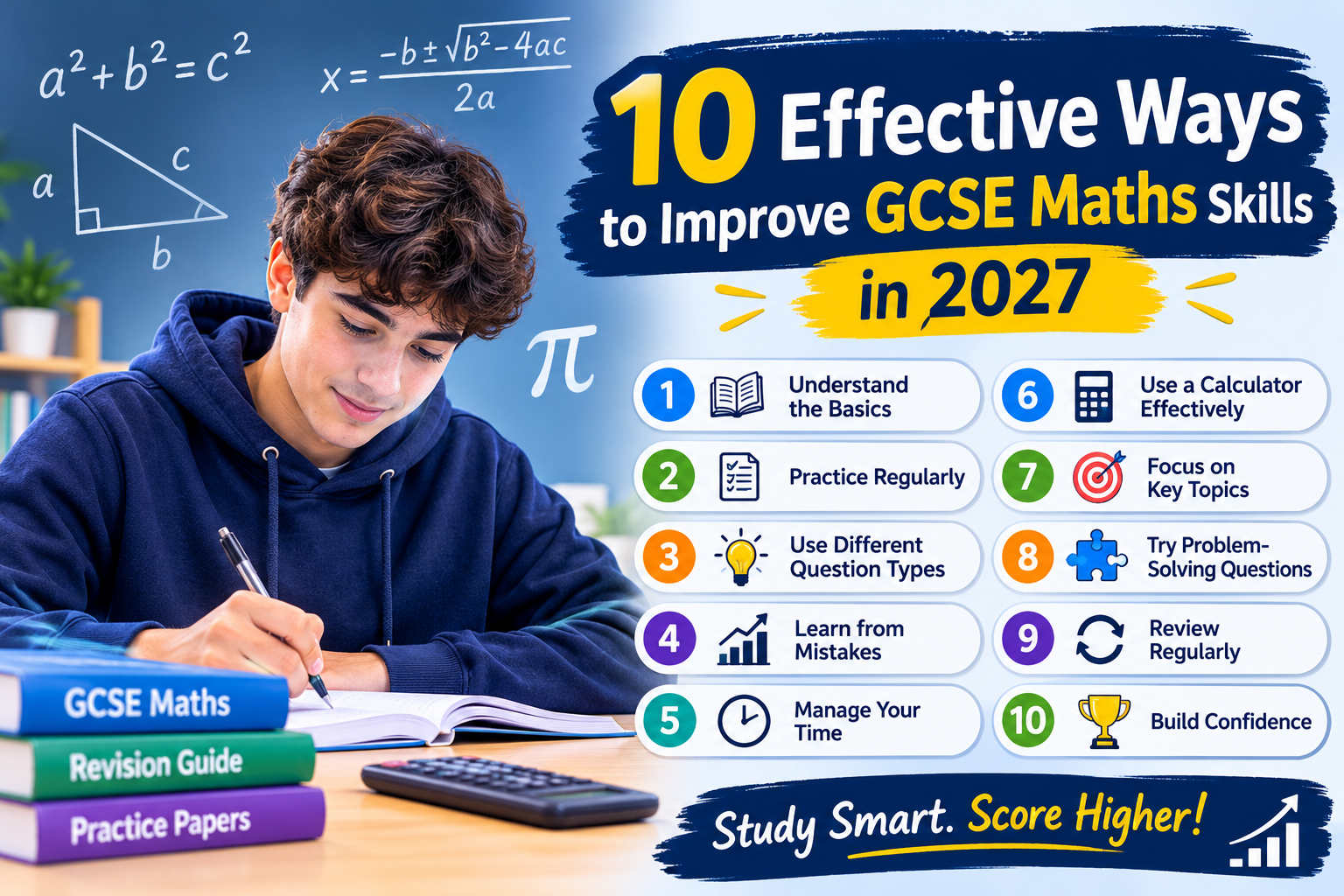

GCSE Maths is an important subject that develops problem-solving, logical thinking and everyday calculation skills. However, many students find certain topics difficult, particularly algebra, geometry, percentages and complex word problems. Improving your maths ability takes regular practice, a clear study plan and the confidence to learn from mistakes.
As the 2027 GCSE examinations approach, students should focus on strengthening their understanding rather than simply memorising formulas. Whether you are preparing for Foundation or Higher Tier Maths, developing good study habits can make a real difference to your progress.
With guidance from experienced online gcse maths tutors, students can receive personalised explanations, practise challenging questions and improve their examination techniques. Here are ten effective ways to develop your GCSE Maths skills in 2027.
1. Build a Consistent Maths Revision Timetable
A structured revision timetable helps you cover different mathematical topics without feeling overwhelmed. Instead of studying everything in one session, divide your revision into smaller sections.
Set Weekly Learning Targets
Choose specific topics for each study session. For example, spend Monday revising algebra, Tuesday practising percentages and Wednesday working on geometry.
Aim for 20–30 minutes of focused maths practice each day. Regular revision helps you remember methods and recognise different question types.
Keep your targets realistic and review your progress every week. If a topic still feels difficult, give it additional attention before moving forward.
2. Strengthen Your Understanding of Basic Mathematical Concepts
Many difficult GCSE questions involve basic mathematical skills. If you struggle with fractions, decimals, negative numbers or multiplication, more advanced topics can become harder to understand.
Master the Fundamentals First
Revise essential skills such as:
-
Fractions, decimals and percentages
-
Ratio and proportion
-
Positive and negative numbers
-
BIDMAS and order of operations
-
Rounding and estimation
Practise these concepts using different question formats. For example, learn how to convert fractions into percentages and apply the same skill to real-life problems involving discounts or money.
A strong understanding of the basics makes more advanced calculations easier to approach.
3. Practise Algebra Step by Step
Algebra is one of the areas where GCSE Maths students often lose marks. It involves working with letters, expressions, equations and mathematical relationships.
Focus on Common Algebra Questions
Start by practising:
-
Simplifying algebraic expressions
-
Expanding and factorising brackets
-
Solving linear equations
-
Substitution into formulas
-
Sequences and nth-term rules
Avoid trying to solve complicated equations too quickly. Write down each step and check your calculations before moving to the next stage.
For example, when solving 3x + 5 = 20, subtract five first and then divide by three. Understanding the process is more valuable than memorising the answer.
4. Improve Your Problem-Solving Skills
GCSE Maths examinations include questions that require students to apply several mathematical skills together. These questions may involve unfamiliar situations or multiple calculation steps.
Learn to Break Down Word Problems
Read each question carefully and identify the information provided. Decide what you need to calculate and which mathematical method is suitable. Underline important figures and look for clues such as total, difference, increase, decrease or proportion.
For example, a question about reducing the price of an item by 15% requires percentage calculations. Practising different real-life examples will help you recognise the correct method more quickly.
5. Use Past Papers for Regular Exam Practice
Past papers are valuable because they introduce you to the structure, difficulty and wording of GCSE Maths questions.
Review Your Mistakes After Every Paper
Choose questions from your exam board and attempt them without looking at the solutions. Once finished, use the mark scheme to check your answers. Create a list of mistakes and group them by topic. This helps you identify whether you struggle with calculations, mathematical reasoning or understanding questions.
Start with individual topic questions before attempting complete papers under timed conditions. This approach gradually builds accuracy and examination confidence.
6. Learn Geometry and Measurement Formulas
Geometry involves shapes, angles, area, volume and measurements. Students need to understand how mathematical rules apply to different figures.
Practise Formulas Through Examples
Revise the formulas for:
-
Area of rectangles and triangles
-
Circumference and area of circles
-
Volume of prisms and cylinders
-
Angles in polygons
-
Perimeter of different shapes
Draw diagrams when answering geometry questions. Label the measurements clearly and identify the information you need.
For 2027 GCSE Maths examinations in England, students will receive a formula sheet. However, learning how and when to apply each formula remains essential. Practise using the relevant sheet during revision so you become familiar with it before the examination.
7. Develop Confidence with Calculator and Non-Calculator Questions
Students need to be comfortable working with and without a calculator. Some questions require mental arithmetic, while others involve more complicated calculations.
Improve Your Calculation Accuracy
Practise using your calculator for fractions, powers, square roots and standard form. Make sure you understand the correct order of operations.
For non-calculator questions, strengthen mental arithmetic through short daily exercises. Learn useful multiplication facts and practise estimating answers.
Always check whether your answer is reasonable. Estimation can help you identify incorrect decimal places, calculation errors and unusual results.
8. Use Online Resources and Interactive Learning Tools
Online learning resources can make maths revision more engaging. Video explanations, topic quizzes and practice worksheets allow students to review difficult concepts at their own pace.
Choose Resources That Match Your GCSE Course
Use materials that follow your exam board's specification. Focus on topics you find challenging rather than spending too much time repeating questions you can already answer confidently. You can also use online quizzes to test your knowledge after completing each topic. Record your results and revisit areas where you need improvement.
Combining independent revision with guided explanations can make your learning more effective.
9. Get Support from Online Maths Tutors
Sometimes, students need additional explanations to understand challenging mathematical concepts. Classroom lessons and independent revision may not always provide enough time to address individual learning gaps.
Choose Personalised GCSE Maths Tuition
Experienced online maths tutors can explain difficult topics, demonstrate calculation methods and provide additional examination practice. Students can receive support with algebra, geometry, statistics, trigonometry and other GCSE Maths topics. One-to-one lessons also allow tutors to adjust explanations according to a student's current understanding.
Mixt Academy UK provides personalised online tuition to help learners strengthen mathematical skills and prepare for examinations. Students looking for additional support can also explore online tutors in London for flexible academic guidance.
10. Develop a Positive Approach to Learning Maths
Confidence plays an important role in mathematical progress. Students sometimes avoid difficult questions because they are worried about getting the wrong answer.
Learn from Every Mistake
Treat mistakes as opportunities to understand where your method went wrong. Review incorrect answers, practise similar questions and try again without looking at the solution. Set small targets, such as improving your accuracy in algebra or completing a geometry exercise independently.
Take regular breaks and celebrate improvements, even when they seem small. Consistent effort can help you become more confident when approaching unfamiliar questions.
Final Thoughts
Improving GCSE Maths skills in 2027 requires consistent practice, strong mathematical foundations and a willingness to tackle challenging questions. From mastering algebra and geometry to practising past papers, every revision activity can help develop your understanding.
Start by identifying your weaker topics and creating a realistic study routine. Use exam-style questions to measure your progress and seek additional guidance when necessary.
With personalised support from online maths tutors, students can work on individual learning gaps, improve problem-solving techniques and prepare more confidently for their GCSE examinations. Mixt Academy UK aims to make learning more accessible through flexible one-to-one online tuition.
Frequently Asked Questions
1. How can I improve my GCSE Maths skills in 2027?
Practise maths regularly, revise difficult topics, complete past papers and review your mistakes. Focus on building strong foundations in algebra, geometry, percentages and problem-solving.
2. Which GCSE Maths topics should I revise first?
Start with topics you find most challenging. Fractions, percentages, algebra, ratio, geometry and probability are useful areas to review. Check your exam board's specification to ensure you cover the required content.
3. How many hours should I study GCSE Maths each day?
You can begin with 20–30 minutes of focused daily practice. Increase your revision time when preparing for mock examinations or final assessments. Consistency is more important than studying for long periods without a clear plan.
4. Can online maths tutors help improve GCSE Maths grades?
Yes. Online tutors can explain difficult concepts, provide personalised practice and identify areas where students need improvement. Regular lessons and independent revision can help students develop stronger mathematical skills.
5. Where can I find online tutors in London for GCSE Maths?
Students can explore Mixt Academy UK's online Maths tuition for personalised academic support. When choosing a tutor, consider their GCSE teaching experience, knowledge of exam boards and ability to explain challenging topics clearly.



