

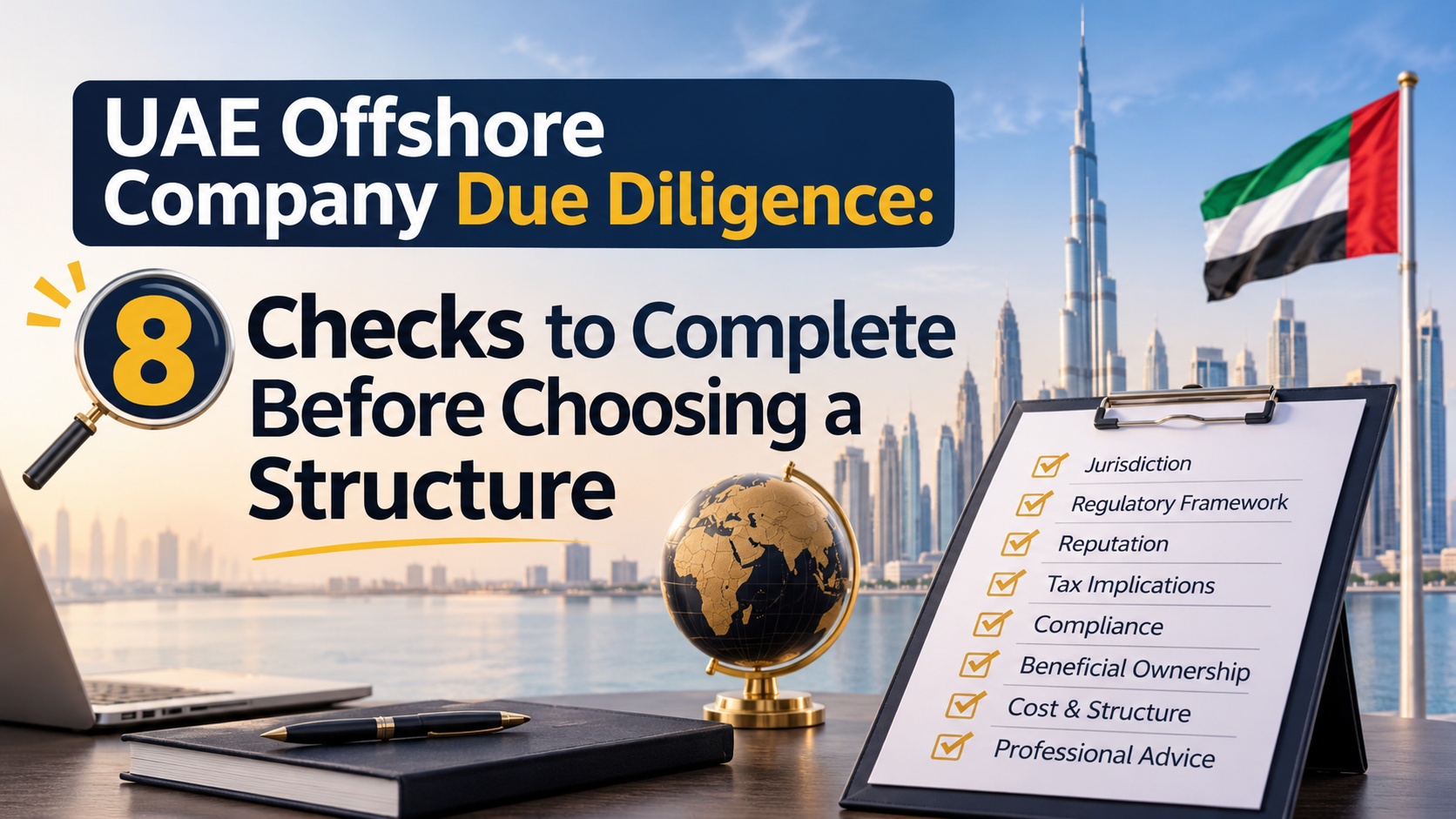
UAE Offshore Company Due Diligence: 8 Checks to Complete Before Choosing a Structure

Choosing an offshore company structure in the UAE requires more than comparing registration fees or selecting a familiar jurisdiction. Investors need to understand what the company will do, which assets it will hold, who will own it and what legal, financial and compliance responsibilities will follow.
A UAE offshore company can be useful for international investment holding, share ownership, asset management and certain cross-border arrangements. However, it may not be suitable for businesses that need to trade directly in the UAE, employ staff or obtain residence visas through the company.
This is why UAE offshore company due diligence should take place before incorporation. It helps investors identify potential restrictions, understand the responsibilities attached to different structures and avoid choosing an entity that does not support their actual business objectives.
The UAE offers different offshore registration options, each with its own regulatory framework and requirements. Investors should therefore assess their needs carefully before committing to a particular structure.
Here are eight important checks to complete before choosing a UAE offshore company.
1. Define the Purpose of Your Offshore Company
The first step is to establish why you need an offshore company. Different structures serve different purposes, so the intended use should guide your decision.
For example, an investor who wants to hold shares in overseas subsidiaries may need a different arrangement from someone planning to hold intellectual property or organise family investments.
Common reasons for considering a UAE offshore company include:
-
Holding shares in other companies.
-
Managing international investments.
-
Holding assets where permitted.
-
Owning intellectual property.
-
Establishing a special purpose vehicle.
-
Organising international business ownership.
-
Creating a holding structure above operating businesses.
JAFZA identifies international trade, holding companies, property ownership and intellectual property as potential uses of its offshore structure, subject to its regulations and permitted activities.
Before selecting a structure, prepare a clear outline of what the company will own, which countries it will deal with and how it will generate or receive income.
It is also important to consider future plans. If you expect to add subsidiaries, transfer shares or acquire investments later, the ownership structure should account for those possibilities.
A clear business purpose makes it easier to compare jurisdictions and identify structures that may not be appropriate for your requirements.
2. Compare the Available UAE Offshore Jurisdictions
The UAE has several offshore registration options, including RAK ICC, JAFZA and Ajman Free Zone. These registries do not operate under one identical set of rules.
Investors should compare the available jurisdictions before deciding where to incorporate.
Two commonly considered options are RAK ICC and JAFZA.
| Consideration | RAK ICC | JAFZA Offshore |
|---|---|---|
| Location | Ras Al Khaimah | Dubai |
| Registration route | Through a registered agent | Through a JAFZA registered agent |
| Corporate structures | Offers different corporate vehicles | Offshore company structure under JAFZA regulations |
| Documentation | Depends on the entity and applicant | Depends on applicant type and registry requirements |
| Regulatory framework | RAK ICC Business Companies Regulations and related rules | JAFZA Offshore Companies Regulations |
| Main consideration | Match the available structure to the intended purpose | Review permitted activities and JAFZA-specific requirements |
JAFZA requires offshore company registration to be processed through its registered agents. Its published guide also identifies different documentation requirements for individual and corporate applicants.
RAK ICC provides its own regulatory framework, company structures and registered-agent arrangements.
Do not choose a jurisdiction simply because someone recommends it or its advertised registration fee appears lower. Compare the legal structure, permitted activities, administrative requirements and long-term costs.
The right choice depends on the company's intended purpose, ownership arrangements, assets and future plans.
3. Check Whether Your Intended Activities Are Permitted
One of the most important parts of offshore company due diligence is checking what the company can legally do.
An offshore company is not the same as a UAE mainland or free zone operating company. Offshore entities generally receive a certificate of incorporation rather than a conventional trade licence for carrying out normal local commercial activities.
This distinction matters because some investors assume that registering an offshore company gives them permission to operate a business throughout the UAE.
That is not necessarily the case.
Before incorporation, check:
-
Whether the intended activity is permitted by the chosen registry.
-
Whether the company can hold the assets you intend to transfer.
-
Whether it can enter into the proposed contracts.
-
Whether the activity involves UAE customers or local operations.
-
Whether another commercial licence or legal entity is required.
-
Whether the intended business model is permitted in the relevant countries.
For example, JAFZA's regulations allow certain activities within the UAE, such as maintaining records, holding meetings, using local professional advisers and holding qualifying property or shares. Other activities may require a licence from the competent authority.
If your business needs a physical office, employees, staff visas or regular commercial operations in the UAE, a mainland or free zone company may be more suitable.
Investors should also consider whether their activities involve regulated sectors or require additional approvals. Choosing a structure without checking these restrictions can create problems after incorporation.
4. Review Shareholder, Director and Beneficial Ownership Requirements
Ownership and management arrangements should be considered before submitting an incorporation application.
Investors need to understand who will own the company, who will manage it and who will ultimately control its activities.
Depending on the selected jurisdiction and structure, relevant considerations may include:
-
Minimum shareholder requirements.
-
Director appointment requirements.
-
Company secretary requirements.
-
Corporate shareholders and directors.
-
Share ownership percentages.
-
Beneficial ownership identification.
-
Appointment and responsibilities of the registered agent.
For example, JAFZA's published setup guidance allows individual and corporate shareholders. Its offshore regulations also contain specific requirements relating to directors, company secretaries and corporate records.
Beneficial ownership should receive particular attention. The ultimate beneficial owner is the natural person who ultimately owns or controls the company, directly or indirectly, under the applicable rules.
Investors should consider whether the proposed ownership structure is transparent, properly documented and capable of meeting relevant disclosure requirements.
A complicated ownership arrangement may require additional corporate documents, ownership charts and supporting evidence. Where a corporate shareholder is involved, the registry or registered agent may also request documents showing the ownership and control of that company.
It is better to establish a clear ownership structure from the beginning than to resolve inconsistencies during a later compliance review.
5. Verify the Registered Agent and Documentation Requirements
UAE offshore companies generally need to follow a registry-specific registration process involving an authorised registered agent.
The agent plays an important role in preparing and submitting documents, communicating with the registry and assisting with the company's administrative requirements.
Before choosing an agent, investors should check:
-
Whether the agent is authorised by the relevant registry.
-
What services are included in the quoted fee.
-
Whether document preparation is included.
-
Whether certification or attestation charges are separate.
-
How annual renewals and amendments are handled.
-
What ongoing support is available after incorporation.
Documentation should also be reviewed before selecting a structure. The requirements can differ depending on whether the shareholder is an individual or an existing company.
For example, JAFZA's published application guide lists documents such as the offshore application, Memorandum and Articles of Association, registered-agent appointment and identification documents. Corporate applicants may also need attested company documents, a board resolution and a power of attorney. The Registrar may request additional documents where necessary.
A document checklist should therefore be obtained from the registered agent before the application begins.
Investors should also confirm whether documents issued overseas need notarisation, legalisation, certification or translation. These requirements can affect both the preparation time and the overall formation budget.
6. Assess the Tax Implications Before Incorporation
Tax planning should be part of the initial structure assessment, not something considered only after the company has been registered.
A common misunderstanding is that an offshore company incorporated in the UAE is automatically exempt from all UAE taxes. This is not a safe assumption.
UAE Corporate Tax treatment depends on the applicable legislation and the company's circumstances. Investors should consider the nature of its income, activities, tax residence, relevant exemptions and any available relief.
Important questions include:
-
Could the company fall within the scope of UAE Corporate Tax?
-
What income will it receive?
-
Will it hold shares or other investments?
-
Could a participation exemption apply to qualifying income?
-
Does it have any UAE business connections or activities?
-
Could its arrangements create tax obligations in another country?
-
Are there reporting or registration requirements to consider?
The tax treatment of a holding company can be different from that of an operating business. However, the company must meet the relevant legal conditions to benefit from any available exemption or relief.
International investors should also consider the tax rules in the countries where the shareholders, subsidiaries and underlying assets are located. A structure that works in the UAE may have different consequences under another country's tax legislation.
For example, the location of management and control, the nature of transactions and the relationship between connected companies may all affect the wider tax position.
Getting appropriate tax advice before incorporation can help investors avoid structures that create unnecessary complexity or fail to achieve the intended outcome.
7. Check Banking, Source of Funds and Financial Requirements
A company may be successfully incorporated but still face challenges when applying for a corporate bank account.
Bank account opening is a separate process. The bank will conduct its own due diligence and decide whether the company meets its requirements.
Before choosing an offshore structure, consider how the company will receive, hold and transfer funds.
Banks may request information such as:
-
Certificate of Incorporation.
-
Memorandum and Articles of Association.
-
Shareholder and director details.
-
Beneficial ownership information.
-
Business plan or explanation of the company's purpose.
-
Expected transaction volumes.
-
Countries involved in business activities.
-
Source of funds and source of wealth evidence.
-
Supporting contracts or investment documents.
The exact requirements depend on the bank, account type, ownership structure and risk assessment.
Investors should also consider whether the proposed company structure is suitable for their expected transactions. A holding company receiving dividends from overseas subsidiaries may have different banking needs from an entity involved in international trading.
Do not assume that incorporation guarantees account approval. Banks may request further information, apply additional checks or decline an application based on their own policies.
It is better to understand the bank's requirements before establishing the structure. Investors should also prepare clear evidence explaining the company's business purpose and expected sources of income.
8. Calculate the Full Formation and Ongoing Compliance Costs
The final check is to understand the total cost of establishing and maintaining the company.
Comparing only the initial registration fee can be misleading. A structure may appear affordable at incorporation but involve additional costs for professional services, documentation, registered-agent support and ongoing administration.
Prepare a budget that considers:
| Cost category | What to consider |
|---|---|
| Incorporation fee | Official registry registration charges |
| Registered-agent fee | Application support and administration |
| Document preparation | Drafting and reviewing corporate documents |
| Certification and attestation | Notarisation, legalisation or certified copies where required |
| Banking support | Documentation and professional assistance |
| Annual renewal | Registry and registered-agent renewal charges |
| Accounting | Record-keeping and financial reporting |
| Tax advisory | Corporate Tax assessment and related support |
| Corporate amendments | Changes to shareholders, directors or company details |
| Additional certificates | Good standing, incumbency and other documents |
The actual expenses depend on the selected jurisdiction and the company's needs. Investors should request an itemised quotation rather than relying on a single advertised formation price.
Ongoing compliance also deserves attention. The company may need to maintain accounting records, update beneficial ownership information, complete registry filings and meet applicable tax obligations.
The requirements are not identical across all UAE offshore registries. For example, JAFZA's Offshore Companies Regulations 2023 contain specific accounting record-retention and financial statement provisions. These should not automatically be treated as requirements for every other UAE offshore jurisdiction.
A realistic budget should therefore cover both the initial formation and the cost of maintaining the structure over several years.
Common Mistakes to Avoid During UAE Offshore Company Due Diligence
Even when investors understand the basic formation process, some important considerations can be overlooked.
Avoid these common mistakes:
-
Choosing based only on price: A low incorporation fee does not necessarily mean lower long-term costs.
-
Ignoring activity restrictions: An offshore company may not be suitable for a business that needs to operate directly in the UAE.
-
Assuming automatic tax exemption: Offshore incorporation does not automatically remove Corporate Tax obligations.
-
Overlooking ownership documentation: Incomplete shareholder or beneficial ownership information can create compliance problems.
-
Assuming banking is guaranteed: Banks conduct independent reviews and may decline applications.
-
Ignoring ongoing responsibilities: Renewal, accounting and regulatory obligations continue after incorporation.
-
Using the wrong structure: A mainland or free zone company may be more suitable for an operating business.
Completing the eight checks before registration can help investors identify these issues while they still have time to compare their options.
Final Thoughts
UAE offshore company due diligence should be completed before selecting a jurisdiction or submitting an incorporation application. Investors need to assess the company's purpose, permitted activities, ownership structure, documentation, tax position, banking requirements and ongoing costs.
RAK ICC, JAFZA and other UAE offshore registries have different rules and procedures. The right choice depends on the company's intended use and the requirements that apply to its shareholders, directors and assets.
A careful review can help investors avoid unsuitable structures and prepare for their responsibilities after incorporation. For investors who need professional assistance with offshore company formation, corporate structuring, tax considerations and compliance planning, Dubai Business and Tax Advisors can help assess the available options before they move forward.



