


Multi-Location SEO Strategy: How to Rank Your Business in Every California City
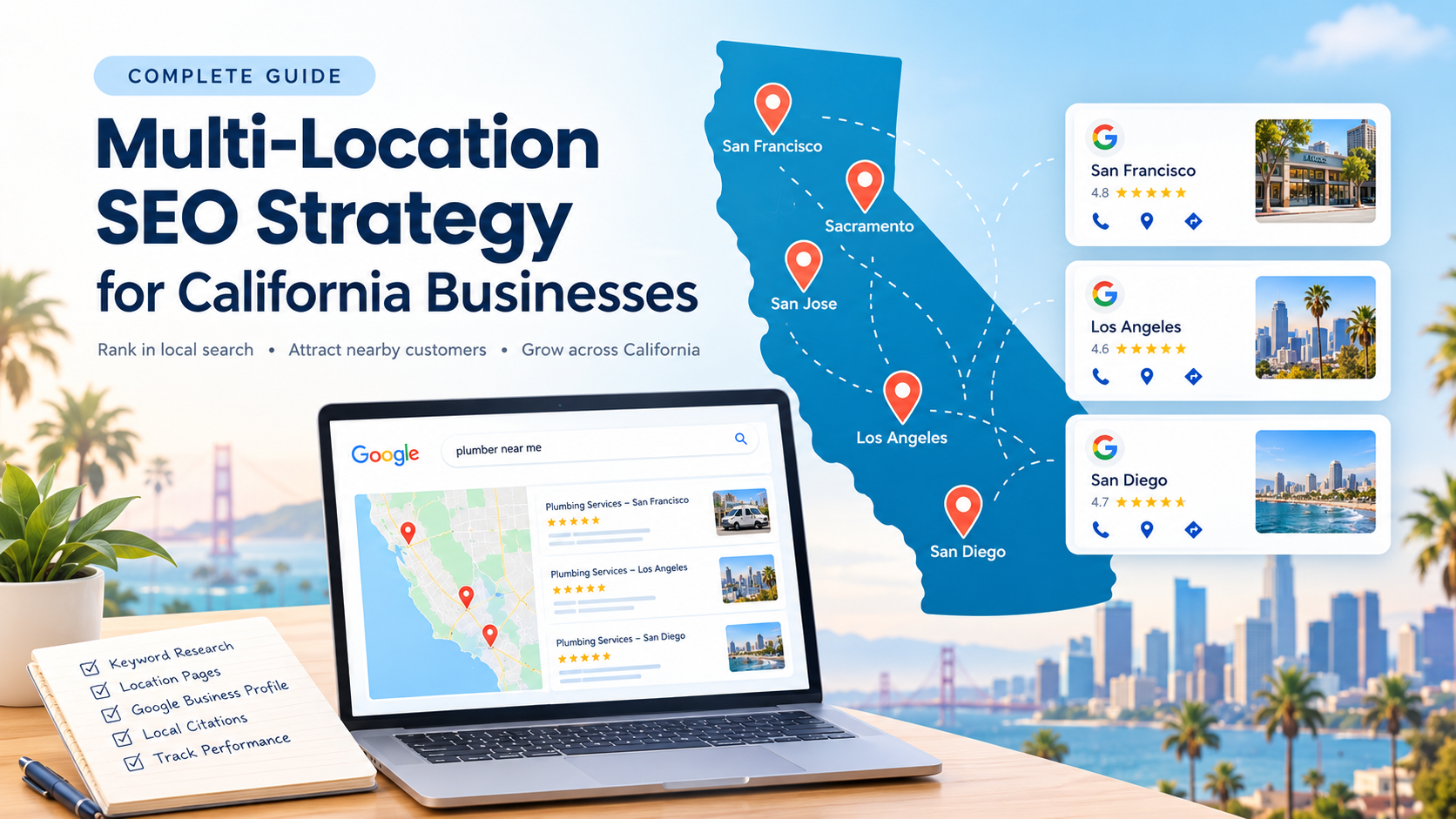
Expanding a business across California creates exciting opportunities, but maintaining strong search visibility in every market requires more than creating a website and adding a list of service areas. Businesses with offices, storefronts, or multiple branches must build a local search presence that reflects each location's services, customers, and competitive environment.
A well-planned multi-location SEO strategy helps businesses improve their visibility in local search results, Google Maps, and relevant organic listings. It also helps potential customers find accurate information about nearby branches, including business hours, contact details, services, and directions.
California presents unique challenges because its business markets range from densely populated metropolitan areas to smaller communities with different customer needs. A strategy that works for a business in Los Angeles may not produce the same results in San Diego, Sacramento, or San Jose.
This guide explains how to organize local SEO for multiple locations, create valuable location pages, optimize Google Business Profiles, and measure performance across California without relying on duplicate content or unrealistic ranking promises.
What Is a Multi-Location SEO Strategy?
A multi-location SEO strategy is a structured approach to improving the online visibility of a business that operates from multiple physical locations. Rather than treating every branch as part of one general local SEO campaign, it establishes relevant search signals for each eligible location while maintaining consistent branding across the website.
For example, a California dental group with offices in Irvine, Anaheim, and San Diego needs accurate information for each office. Patients should be able to find the correct address, available treatments, operating hours, and contact information when searching for a nearby practice.
An effective strategy typically includes:
-
Individual Google Business Profiles for eligible business locations.
-
Dedicated website pages with genuinely useful local information.
-
Consistent business details across relevant online directories.
-
Location-specific customer reviews and community references.
-
Relevant internal links connecting branches to services.
-
Performance tracking for each location.
The objective is not to rank every branch for every search throughout California. It is to help each location become more visible to relevant customers in its actual market.
Why Is Multi-Location SEO Important for California Businesses?
California has diverse local markets, and customer search behavior varies by city, neighborhood, and service category. A business with several branches must compete against local businesses as well as national brands that may have greater online visibility.
A consistent approach to local search optimization can help businesses manage this complexity while providing customers with more relevant information.
Reach customers searching for nearby services
People frequently include a city, neighborhood, or location-based phrase in searches when looking for professional services, restaurants, retailers, and other businesses.
Location-specific pages can help search engines understand which branch serves a particular need. Accurate Google Business Profile information can also help eligible businesses appear in Google Maps and local search results.
Build trust in every service area
Customers want to know whether a business genuinely operates near them. Accurate addresses, real photographs, location-specific reviews, and clear contact information provide useful evidence about each branch.
When information differs between a website and its business listings, customers may become confused. Maintaining accurate details supports a more reliable customer experience.
Make expansion easier to manage
As a business grows from two locations to ten or more, managing SEO manually becomes increasingly complicated. A repeatable system for page creation, profile updates, review management, and reporting reduces errors and makes it easier to maintain quality.
However, standardization should apply to the process, not to the entire content of every location page. Each branch still needs information that reflects its own services and market.
1. Research Local Keywords for Every California Location
Keyword research should be the starting point for building a location-based SEO campaign. Businesses need to understand what customers search for, which services matter in each market, and how local competitors present their offerings.
Start by identifying your core services and combining them with relevant geographic modifiers.
For example, a plumbing company might investigate phrases such as:
-
Emergency plumber in Sacramento.
-
Residential plumbing services in San Jose.
-
Drain cleaning in Oakland.
-
Water heater repair in Fresno.
-
Licensed plumber in Riverside.
These are examples of keyword research opportunities, not claims about their current search volume or competition.
How to organize your keyword research
Create a spreadsheet that maps each location to its primary services, target keywords, and corresponding website pages.
Separate keywords according to search intent. Someone searching for a service near them may be ready to contact a provider, while someone searching for maintenance advice may need an informational article.
Useful research sources include Google Search Console, Google Keyword Planner, competitor websites, and relevant search results.
Avoid targeting every possible city-service combination automatically. A separate page is most useful when it serves a distinct search need and provides meaningful information about the business's availability in that market.
2. Optimize Google Business Profile for Every Eligible Location
Google Business Profile is an important part of local SEO for businesses with multiple branches. It allows eligible businesses to manage how their locations appear across Google Search and Maps.
Each qualifying location should have its own accurate profile. Businesses should follow Google's eligibility requirements and avoid creating profiles for virtual offices, mailing addresses, or locations where the business does not actually operate.
Google Business Profile optimization checklist
For every eligible branch:
-
Use the real-world business name without unnecessary keywords.
-
Select the most relevant primary business category.
-
Provide the correct address and local phone number.
-
Update business hours, including applicable holiday hours.
-
Add accurate descriptions of the services offered.
-
Upload genuine photographs of the location, staff, or work.
-
Link the profile to its corresponding website location page.
-
Monitor customer reviews and respond professionally.
Businesses operating ten or more eligible locations may be able to use Google's bulk verification process, subject to its requirements.
It is important to understand that completing a profile does not guarantee a particular ranking. Google identifies relevance, distance, and prominence as key factors in local search results. A business cannot control every factor, particularly the searcher's distance from the location.
3. Create Unique Location Pages for Every Branch
Location pages are one of the most important elements of an effective multi-location website.
A dedicated page helps visitors understand what a particular branch offers and gives search engines a clear destination associated with that location. However, simply copying a page and replacing the city name is unlikely to provide much value.
Each page should answer questions that a customer might have before visiting or contacting that branch.
What should a location page include?
A useful location page may contain:
-
The branch's official business name, address, and phone number.
-
Accurate operating hours and contact options.
-
Services actually available at that location.
-
Original photographs of the office, storefront, or team.
-
Directions, parking information, and nearby landmarks where relevant.
-
Genuine testimonials or reviews associated with that branch.
-
Answers to location-specific customer questions.
-
A clear call to action, such as calling, booking, or requesting a quote.
For instance, a law firm's Irvine office may have different attorneys, practice areas, and appointment arrangements from its Sacramento office. Those differences should be reflected in the respective pages.
The objective is to make every page independently useful rather than creating landing pages solely to capture additional keyword variations.
4. Build a Clear Website Structure for Multiple Locations
A well-organized website makes it easier for visitors and search engines to navigate between branches.
A central locations directory can introduce the business's available locations and link to individual pages. Businesses with numerous branches may also benefit from regional directories, provided these pages serve a genuine organizational purpose.
A simple structure might look like this:
Homepage
Brand overview and main services
Locations Directory
Links to the business's real branches
Los Angeles
Branch page
San Diego
Branch page
Sacramento
Branch page
Use a consistent URL pattern, such as /locations/los-angeles/ or /locations/san-diego/, where it fits the website's structure.
Internal links should connect location pages to relevant services and help visitors move naturally between related sections. Make sure important pages are accessible through standard crawlable links rather than relying exclusively on interactive maps or search forms.
5. Maintain Consistent Business Information Across Online Directories
Name, address, and phone number (NAP) consistency helps customers identify the correct business and location across the web.
When a business has several branches, the risk of inaccurate information increases. An outdated phone number in one directory or an old address on a third-party website can send potential customers to the wrong place.
How to manage local citations
Start by documenting the correct details for every branch in a central spreadsheet. Then review the business's website, Google Business Profiles, relevant industry directories, and trusted local listings.
Prioritize directories that matter to the industry and geographic market rather than submitting the same information indiscriminately to hundreds of low-quality websites.
When a location moves, changes its phone number, or closes, update the relevant listings and website pages promptly. Retain appropriate redirects for old URLs when necessary, and ensure that closed locations are represented accurately.
Consistent information is a foundation for effective local SEO, but it does not independently guarantee better rankings.
6. Develop a Location-Specific Review Strategy
Customer reviews can influence how potential customers evaluate a business, and Google's published local ranking guidance identifies prominence as one of the factors involved in local results.
For a multi-location business, review management should happen at the branch level. A strong reputation at one office does not mean every other branch has the same customer experience or review profile.
Ways to manage reviews responsibly
-
Invite customers to share honest feedback after a genuine interaction.
-
Make it easy for customers to find the correct branch's review page.
-
Respond to positive and negative feedback professionally.
-
Address recurring service complaints with the relevant team.
-
Monitor review activity across all locations.
-
Avoid incentives, fabricated reviews, or attempts to suppress legitimate negative feedback.
Businesses should also avoid pressuring customers to leave only positive reviews. The goal is to collect authentic feedback and use it to improve service quality.
A regular review process makes it easier to identify branches that need operational improvements and maintain consistent customer communication across the business.
7. Create Local Content That Reflects Each California Market
A business serving multiple California cities should understand that local content is not simply a collection of city names.
Useful local content answers questions about the services available, the needs of customers in that market, and the practical details of working with the business.
For example, a roofing company may publish maintenance guidance relevant to its service offering, explain the inspection process, or answer questions commonly raised by customers at a particular branch. Any regional advice should be accurate and relevant to the actual service.
Content ideas for multi-location businesses
-
Location-specific service guides.
-
Frequently asked questions based on real customer inquiries.
-
Introductions to branch teams and specialists.
-
Case studies from completed projects, with appropriate permission.
-
Local event participation and community updates.
-
Guides explaining how to choose a relevant service provider.
-
Useful information about appointments, accessibility, and service availability.
Avoid publishing dozens of nearly identical articles just to target additional California cities. Google's spam policies address doorway abuse, including pages created for similar geographic queries that funnel users toward the same destination without offering distinct value.
A smaller number of genuinely useful pages is often a better starting point than a large collection of repetitive landing pages.
8. Use LocalBusiness Structured Data Correctly
Structured data helps search engines interpret information about a business and its locations. For multi-location websites, relevant LocalBusiness structured data can clarify details such as a branch's name, address, opening hours, and contact information.
Each location page should describe the actual business represented on that page. Choose the most specific appropriate business subtype supported by the available information.
For example, a business with separate physical offices can use structured data to describe each location accurately rather than assigning every branch the same address.
Before publishing, check the following:
-
The structured data matches visible page content.
-
The address and business name are accurate.
-
Opening hours and phone numbers reflect the actual branch.
-
Markup follows Google's current structured data documentation.
-
The page does not contain fabricated reviews or other misleading information.
You can use Google's Rich Results Test where applicable and inspect indexing status in Google Search Console.
Structured data can help Google understand a page, but it does not guarantee enhanced search results or higher rankings.
9. Earn Relevant Local Backlinks
Backlinks from relevant websites can help search engines discover content and understand its connections to other sources. For multi-location businesses, local relationships can also introduce a branch to people in its community.
A California business may explore legitimate opportunities with local trade associations, chambers of commerce, community organizations, industry publications, and event partners.
Practical local link-building ideas
-
Participate in relevant community initiatives.
-
Publish original research or helpful resources that local organizations may reference.
-
Contribute expert insights to appropriate industry publications.
-
Sponsor legitimate local events when there is a genuine business fit.
-
Build partnerships with complementary businesses.
-
Share useful project stories with permission from the people involved.
Links should be earned through relevant relationships and valuable contributions. Avoid buying links intended to manipulate rankings or creating large numbers of low-quality directory submissions.
Where appropriate, link to the relevant branch page rather than always pointing to the homepage. This helps visitors reach the information most relevant to the local relationship.
10. Track SEO Performance Separately for Every Location
Measuring performance at the brand level can hide significant differences between branches. One location may receive many calls while another struggles to attract qualified traffic.
A multi-location reporting system should help identify these differences and guide the next round of improvements.
|
Metric |
What it helps you understand |
|---|---|
|
Organic clicks and impressions |
How website pages perform in Google Search |
|
Local search visibility |
How branches appear for relevant local searches |
|
Google Business Profile interactions |
Customer actions such as calls and direction requests |
|
Website conversions |
Leads, bookings, and other valuable actions |
|
Review trends |
Customer feedback and reputation patterns |
|
Location-page engagement |
How visitors interact with branch-specific content |
Google Search Console can help you review organic performance by page and query. Google Analytics can provide additional insight into website engagement and conversions when tracking is configured correctly.
Google Business Profile performance reports can provide information about profile interactions, subject to the metrics available for each profile.
For more useful comparisons, assess rankings from multiple geographic points around each branch. A search performed next to an office may show different results from a search performed several miles away.
Review the data regularly and prioritize the locations with the clearest opportunities for improvement.
Common Multi-Location SEO Mistakes to Avoid
Even businesses with established websites can undermine their local search strategy through preventable errors.
Creating duplicate location pages: Replacing only the city name on a template does not give visitors a meaningful reason to visit each page.
Setting up ineligible business profiles: Virtual offices and locations without the required real-world presence should not be represented as qualifying branches.
Using inconsistent contact information: Different addresses or phone numbers can confuse customers and complicate listing management.
Ignoring internal links: Important branch pages should be accessible from the locations directory and relevant service pages.
Treating every California city as a branch: A city where a business provides services is not necessarily a physical office eligible for its own Google Business Profile.
Tracking only overall website traffic: Aggregate data can hide weak performance at individual locations.
Expecting immediate rankings: Local SEO results vary with competition, location, relevance, distance, and other factors. There is no guaranteed ranking timeline.
Addressing these issues creates a stronger foundation for sustainable organic visibility.
How to Build a Practical Multi-Location SEO Action Plan
A clear implementation plan helps businesses prioritize essential work before expanding into additional content and link-building activities.
Phase 1: Audit existing locations
Document actual addresses, eligible profiles, website pages, services, contact details, and existing search performance.
Phase 2: Fix local foundations
Correct business profiles, resolve technical issues, improve location-page content, and standardize directory information.
Phase 3: Strengthen relevance
Develop useful local content, improve internal linking, collect authentic customer feedback, and build relevant local relationships.
Phase 4: Measure and refine
Compare traffic, visibility, leads, and customer interactions by branch, then prioritize the next improvements using actual performance data.
This process can be adapted for small businesses with two branches and larger organizations managing many locations. The scale of the operation may change the tools and workflow, but accuracy and location-specific value remain essential.
Frequently Asked Questions
What is the best multi-location SEO strategy?
The best approach combines accurate Google Business Profiles for eligible locations, useful individual location pages, consistent business listings, relevant local content, and performance tracking by branch. The exact priorities depend on the business, its markets, and its existing search visibility.
How do I rank my business in multiple California cities?
Start by identifying where your business genuinely operates and which services it offers in each market. Optimize eligible business profiles, build relevant location pages, maintain accurate contact details, and develop content that addresses local customer needs. Rankings will vary according to competition, relevance, distance, and other factors.
Should every business location have its own website page?
A dedicated page is generally useful for each real branch when it provides meaningful information about that location. The page should include accurate contact details, available services, and useful local information. Avoid creating thin pages that differ only by city name.
Can one Google Business Profile rank in multiple California cities?
A single profile can appear in relevant local searches beyond its immediate neighborhood, but visibility depends partly on the searcher's distance and the business's relevance and prominence. Creating extra profiles for cities without eligible real-world locations is not an appropriate workaround.
How important are customer reviews for multi-location SEO?
Reviews help potential customers evaluate a business and contribute to Google's prominence signals. Managing feedback at each branch helps businesses understand customer experiences and maintain accurate, location-specific reputations. Reviews alone do not guarantee a particular ranking.
How long does multi-location SEO take to show results?
There is no fixed timeline. Results depend on the current state of the website, the competitiveness of each market, indexing, business profile eligibility, content quality, and other factors. Monitor performance over time instead of relying on a promised number of days or months.
How can I prevent my locations from competing against one another?
Give each location page a clear purpose, accurate branch information, and content relevant to its actual services and customers. Use appropriate internal links and avoid creating multiple pages targeting identical queries without a meaningful difference in purpose. Track each branch separately to identify overlapping keywords and performance problems.
Conclusion
Ranking multiple business locations across California requires a coordinated approach to local search optimization. Every eligible branch needs accurate business information, an appropriate Google Business Profile, and a website destination that genuinely helps local customers.
A strong multi-location SEO strategy also depends on useful content, relevant local relationships, consistent listings, and reporting that reveals how each branch performs. Rather than creating more pages simply to target additional cities, focus on making every location easier to find, understand, and contact.
For businesses that need help with local keyword research, technical SEO, location-page optimization, or ongoing search visibility, SEOCALI provides an entry point to explore SEO resources and services.
By combining consistent processes with genuine local relevance, California businesses can build a more organized online presence and create a stronger foundation for long-term growth.
- Goth Lifestyle
- Fashion & Style
- Music & Bands
- Art & Photography
- Creative Writing & Poetry
- Events & Scene
- Occult & Spirituality
- DIY & Tutorials
- Beauty & Self-Care
- Relationships & Dating
- Gaming & Media
- Tech & Gadgets
- Body Art & Piercings
- Underground Culture
- Spotlights & Interviews
- Travel & Places
- Lifestyle & Daily Life
- Fitness & Health
- Travel & Adventure
- Books & Literature
- Tech & Gaming
- Movies & TV
- Food & Drinks
- Humor & Memes
- Pets & Animals
- General Arts & Crafts

 English
 Arabic
 French
 Spanish
 Portuguese
 Deutsch
 Turkish
 Dutch
 Italiano
 Romaian
 Portuguese (Brazil)
 Greek
