


Fenbendazole for Cats: Dosage Chart by Weight
Fenbendazole is a broad-spectrum antiparasitic medication that veterinarians may use to treat certain intestinal parasites in cats. It belongs to the benzimidazole group of deworming medicines and is commonly discussed in connection with roundworms, hookworms, and some other gastrointestinal parasites. The correct dose and treatment length depend on the cat’s weight, age, health status, and the specific parasite being treated.
When researching deworming options, pet owners may come across veterinary information and medication resources such as medslike.com. However, online dosage information should not replace advice from a veterinarian. Fenbendazole products can come in different strengths and formulations, so calculating the correct amount requires knowing the exact product concentration as well as the cat’s body weight.
What is fenbendazole used for in cats?
Fenbendazole is primarily used as an anthelmintic, meaning it works against certain parasitic worms. Veterinarians may prescribe it for infections involving roundworms, hookworms, whipworms, and some other parasites. Its effectiveness varies depending on the organism, so it should not be assumed to treat every type of intestinal parasite.
A veterinarian may also recommend additional testing when a cat has persistent diarrhea, weight loss, vomiting, poor appetite, or other gastrointestinal symptoms. A stool examination can help identify the parasite involved and determine whether fenbendazole is an appropriate treatment.
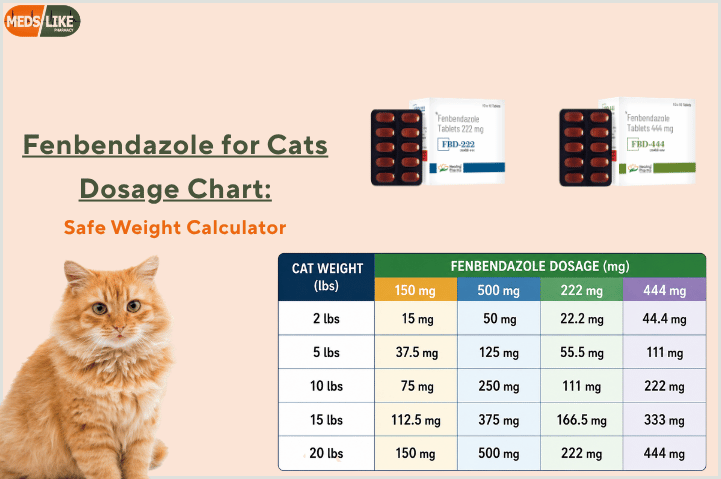
Fenbendazole dosage chart by cat weight
A commonly referenced veterinary dosing approach for fenbendazole in cats is 50 mg per kg of body weight once daily, often for several consecutive days depending on the parasite and the veterinarian’s treatment plan.
The table below shows the amount of fenbendazole in milligrams based on that 50 mg/kg calculation:
| Cat weight | Approximate fenbendazole amount at 50 mg/kg |
|---|---|
| 2 kg (4.4 lb) | 100 mg |
| 2.5 kg (5.5 lb) | 125 mg |
| 3 kg (6.6 lb) | 150 mg |
| 3.5 kg (7.7 lb) | 175 mg |
| 4 kg (8.8 lb) | 200 mg |
| 4.5 kg (9.9 lb) | 225 mg |
| 5 kg (11 lb) | 250 mg |
| 5.5 kg (12.1 lb) | 275 mg |
| 6 kg (13.2 lb) | 300 mg |
| 7 kg (15.4 lb) | 350 mg |
| 8 kg (17.6 lb) | 400 mg |
Important: This is a calculation chart, not an individualized prescription. The appropriate treatment duration and formulation should be determined by a veterinarian.
How to calculate the dose
The basic calculation is:
Cat’s weight in kilograms × 50 mg = daily fenbendazole amount
For example, a cat weighing 4 kg would correspond to:
4 kg × 50 mg/kg = 200 mg per day
This calculation gives the amount of active fenbendazole, not necessarily the volume of liquid medication to administer. If the product is a liquid suspension, the concentration on the label must be used to convert milligrams into milliliters.
For example, a product containing 100 mg/mL would require a different volume than a product containing 50 mg/mL. Because formulations vary, never assume that a particular number of milliliters is appropriate simply because the cat’s weight is known.
How long is fenbendazole given to cats?
The duration of treatment depends on the parasite and the veterinarian’s diagnosis. Some intestinal worm infections may be treated over several consecutive days, while other conditions require a different medication or treatment schedule.
This is especially important because symptoms alone cannot reliably identify a particular parasite. Diarrhea, vomiting, poor appetite, and weight loss can occur with many different feline diseases. Giving fenbendazole for an incorrect duration may fail to eliminate the underlying problem.
If symptoms continue after treatment, a veterinarian may recommend another fecal examination or a different diagnostic approach rather than simply extending the medication.
Fenbendazole safety in cats
Fenbendazole is generally considered well tolerated when used appropriately, but side effects can occur. Possible reactions may include vomiting, diarrhea, reduced appetite, or other gastrointestinal upset.
Cats that are very young, elderly, pregnant, debilitated, or affected by other medical problems may need additional veterinary guidance before receiving an antiparasitic medication. The same applies to cats already taking other medicines.
Pet owners should also avoid using a dog or livestock deworming product without confirming that its formulation and concentration are appropriate for cats. Different products may contain different active ingredients, concentrations, or additional substances.
What if you miss a dose?
If a prescribed dose is missed, the safest approach is to contact the veterinarian or follow the instructions supplied with the specific medication. Do not automatically double the next dose to compensate.
If a cat vomits shortly after receiving fenbendazole, ask the prescribing veterinarian whether the dose should be repeated. The answer can depend on how much time passed and whether any of the medication was absorbed.
When should a cat see a veterinarian?
A cat should receive veterinary attention if it has persistent vomiting or diarrhea, blood in the stool, significant weight loss, weakness, dehydration, severe abdominal discomfort, or a major change in appetite or behavior.
Kittens can become dehydrated more quickly than healthy adult cats, so gastrointestinal symptoms in young cats deserve particular attention. A veterinarian can determine whether parasites are actually responsible and select treatment based on the diagnosis.
Final thoughts
Fenbendazole can be a useful veterinary deworming medication for certain feline parasite infections, but the correct treatment depends on more than a cat’s weight. A weight-based calculation can help explain how a dose is determined, but the exact product concentration, parasite involved, treatment duration, and the cat’s overall health must also be considered.
Use the dosage chart as an educational reference rather than as a substitute for veterinary instructions. Before giving fenbendazole to a cat, confirm the dose and formulation with a veterinarian, particularly when treating a kitten, pregnant cat, elderly cat, or a cat with other health problems.
- Goth Lifestyle
- Fashion & Style
- Music & Bands
- Art & Photography
- Creative Writing & Poetry
- Events & Scene
- Occult & Spirituality
- DIY & Tutorials
- Beauty & Self-Care
- Relationships & Dating
- Gaming & Media
- Tech & Gadgets
- Body Art & Piercings
- Underground Culture
- Spotlights & Interviews
- Travel & Places
- Lifestyle & Daily Life
- Fitness & Health
- Travel & Adventure
- Books & Literature
- Tech & Gaming
- Movies & TV
- Food & Drinks
- Humor & Memes
- Pets & Animals
- General Arts & Crafts

 English
 Arabic
 French
 Spanish
 Portuguese
 Deutsch
 Turkish
 Italiano
 Russian
 Romaian
 Portuguese (Brazil)
 Greek
Greek
