


Digital Archiving vs. Backup: Which One Does Your Business Need?
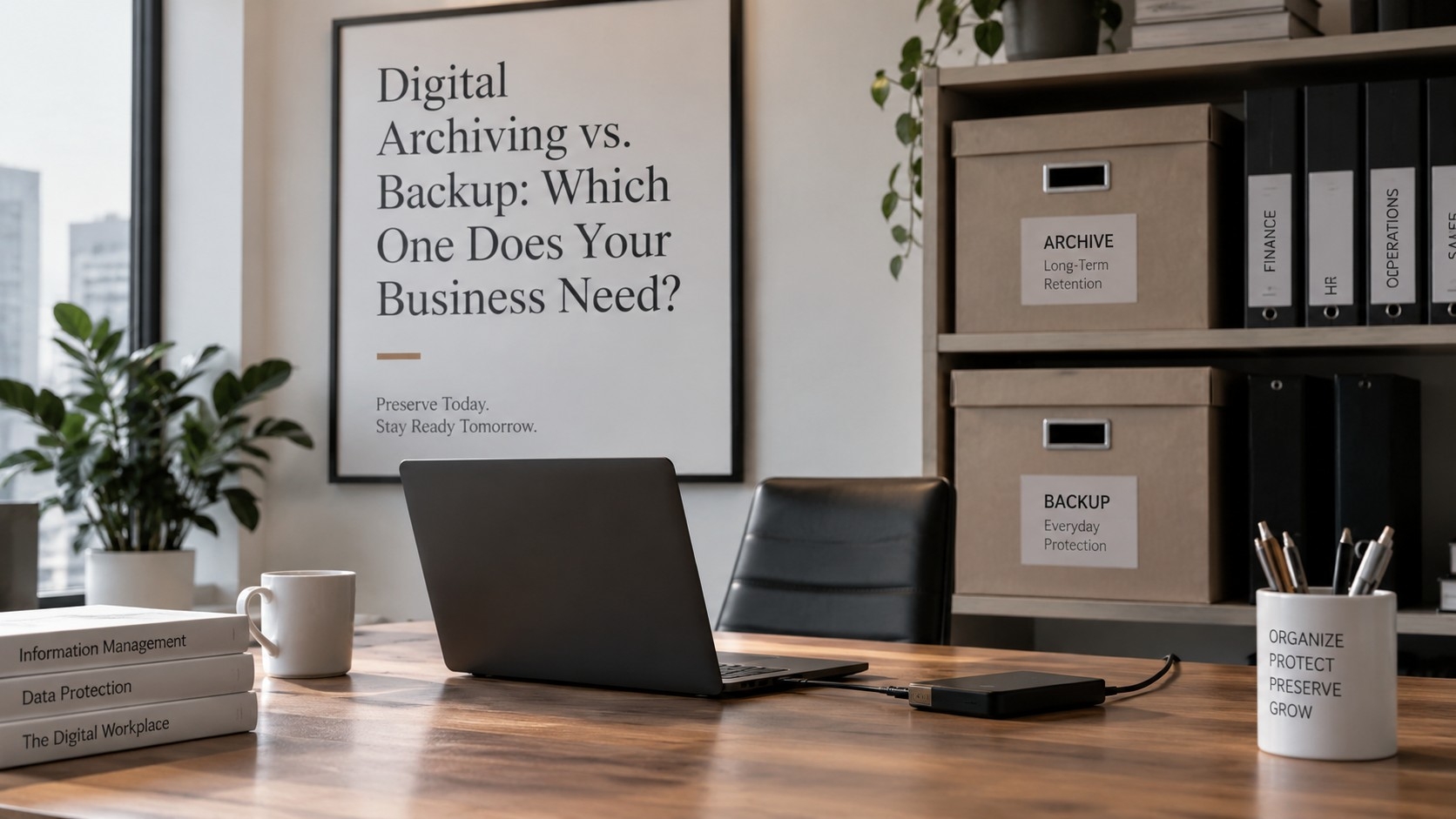
Businesses generate and store large amounts of digital information, from financial statements and customer records to contracts, employee files, and operational documents. Keeping this information safe is essential, but simply storing files does not guarantee that they will remain accessible, trustworthy, or useful for years to come.
Two common approaches to protecting business information are digital archiving and data backup. Although they may seem similar, they serve different purposes. Understanding the difference helps businesses choose the right strategy for protecting information, recovering from disruptions, and meeting long-term recordkeeping requirements.
What is Digital Archiving?
Digital archiving is the process of preserving electronic records so they remain accessible, searchable, and trustworthy over an extended period. It involves more than saving files in a digital repository. A well-managed archive also considers metadata, retention policies, access permissions, document integrity, and the ability to retrieve records when they are needed.
For example, a company may need to preserve signed contracts, insurance claims, or financial records long after the original transaction has ended. These documents might be required for audits, legal proceedings, regulatory reviews, or historical reference.
Solutions such as Docbyte's Digital Archiving platform help organizations manage records throughout their retention lifecycle. This includes maintaining access, preserving relevant context, and supporting auditability even when the original business systems change.
What is Data Backup?
Data backup involves creating copies of information so it can be restored after accidental deletion, hardware failure, cyberattacks, software problems, or other disruptive events. Backups are an important part of business continuity and disaster recovery planning.
For instance, if a company's server fails, its IT team can use a recent backup to recover important files and restore operations. Depending on the backup strategy, copies may be stored on separate servers, external devices, or cloud infrastructure.
Backups are generally designed around recovery objectives, such as how much data a business can afford to lose and how quickly its systems must be restored. They are not necessarily organized for long-term records management, regulatory retention, or the preservation of a document's evidential value over many years.
Digital Archiving vs. Backup: Key Differences
Although digital archiving and data backup both help protect business information, they serve different purposes.
Purpose and retention: Digital archiving focuses on preserving important records for long-term access and retrieval. Retention periods are often based on business needs, legal obligations, and regulatory requirements. Backups, on the other hand, are designed to restore information after accidental deletion, system failures, or cyber incidents.
Access and retrieval: Digital archives typically organize records using metadata, indexing, and search capabilities. This helps employees locate specific documents when needed for audits, business decisions, or legal reviews. Backups primarily support data restoration and may not provide the same level of document search and records management.
Integrity and accountability: Digital archiving may include controls for maintaining document integrity, preserving metadata, and tracking access or changes. Backup systems focus on maintaining recoverable copies of data. The controls available depend on the specific solution and its configuration.
System changes and long-term preservation: Businesses may need to retain records after replacing older applications or retiring legacy systems. A digital archive can help preserve records independently of the original application, provided the archive supports suitable formats and preservation processes. Backups help restore data and systems from available copies but do not automatically address long-term accessibility or retention governance.
Typical use cases: Digital archiving is useful for contracts, financial records, compliance documents, and other information that must remain accessible over time. Backups are essential for recovering servers, restoring deleted files, and resuming operations after technical disruptions.
These approaches can overlap in some capabilities, but maintaining backups for an extended period does not automatically replace a structured digital archiving strategy.
The exact capabilities depend on how each solution is configured. Some backup platforms offer long retention periods, while some archiving systems include redundancy and recovery features. However, extended backup retention alone does not automatically provide the governance and preservation controls of a dedicated digital archive.
Why Businesses Need Both
Choosing between digital archiving and backup is not necessarily an either-or decision. Many businesses need both because the two approaches address different risks.
Consider an organization that stores signed customer agreements in its document management system. Regular backups help the company recover files if the system is damaged or compromised. Digital archiving helps preserve selected agreements, their metadata, and relevant evidence throughout their required retention periods.
Without backups, the organization could struggle to restore operations after a major incident. Without appropriate archiving, it might have difficulty locating older records, demonstrating their integrity, or managing retention obligations after its systems change.
Cybersecurity guidance also emphasizes the importance of maintaining recoverable data copies. The U.S. Cybersecurity and Infrastructure Security Agency's ransomware guidance recommends maintaining offline, encrypted backups and regularly testing their availability and integrity. These measures support recovery, but they do not replace a structured approach to long-term record preservation.
How to Decide Which Solution Your Business Needs
Start by identifying why the information must be retained. If the primary concern is recovering files after accidental deletion, hardware failure, or a cyber incident, a reliable backup strategy is essential.
If records must remain searchable, accessible, and trustworthy for several years, digital archiving may be necessary. This is particularly relevant for businesses operating in regulated industries or handling contracts, financial documents, insurance records, and other information that may need to be produced during an audit or dispute.
Next, review your retention requirements, security controls, and existing IT infrastructure. Consider who needs access to the information, how long it must be retained, and whether the organization can retrieve records without depending on outdated software.
Finally, evaluate how the two systems will work together. A clear policy should define which information is backed up, which records enter the archive, how long each is retained, and when data can be securely deleted.
Conclusion
Digital archiving and data backup are complementary parts of a strong information management strategy. Backups help businesses recover from data loss, while digital archiving supports the long-term preservation, organization, and retrieval of important records.
The right approach depends on your organization's recovery needs, retention obligations, and the value of its digital information. Businesses that want to strengthen their understanding of technology and practical digital solutions can also explore relevant discussions and community resources through online technology and digital culture communities.
By defining the purpose of each system and establishing clear policies, businesses can protect their information today while keeping essential records usable in the future.
- Goth Lifestyle
- Fashion & Style
- Music & Bands
- Art & Photography
- Creative Writing & Poetry
- Events & Scene
- Occult & Spirituality
- DIY & Tutorials
- Beauty & Self-Care
- Relationships & Dating
- Gaming & Media
- Tech & Gadgets
- Body Art & Piercings
- Underground Culture
- Spotlights & Interviews
- Travel & Places
- Lifestyle & Daily Life
- Fitness & Health
- Travel & Adventure
- Books & Literature
- Tech & Gaming
- Movies & TV
- Food & Drinks
- Humor & Memes
- Pets & Animals
- General Arts & Crafts

 English
 Arabic
 French
 Spanish
 Portuguese
 Deutsch
 Turkish
 Dutch
Dutch
 Italiano
 Romaian
 Portuguese (Brazil)
 Greek
Greek
