


How Virtual Product Experiences Are Changing E-Commerce
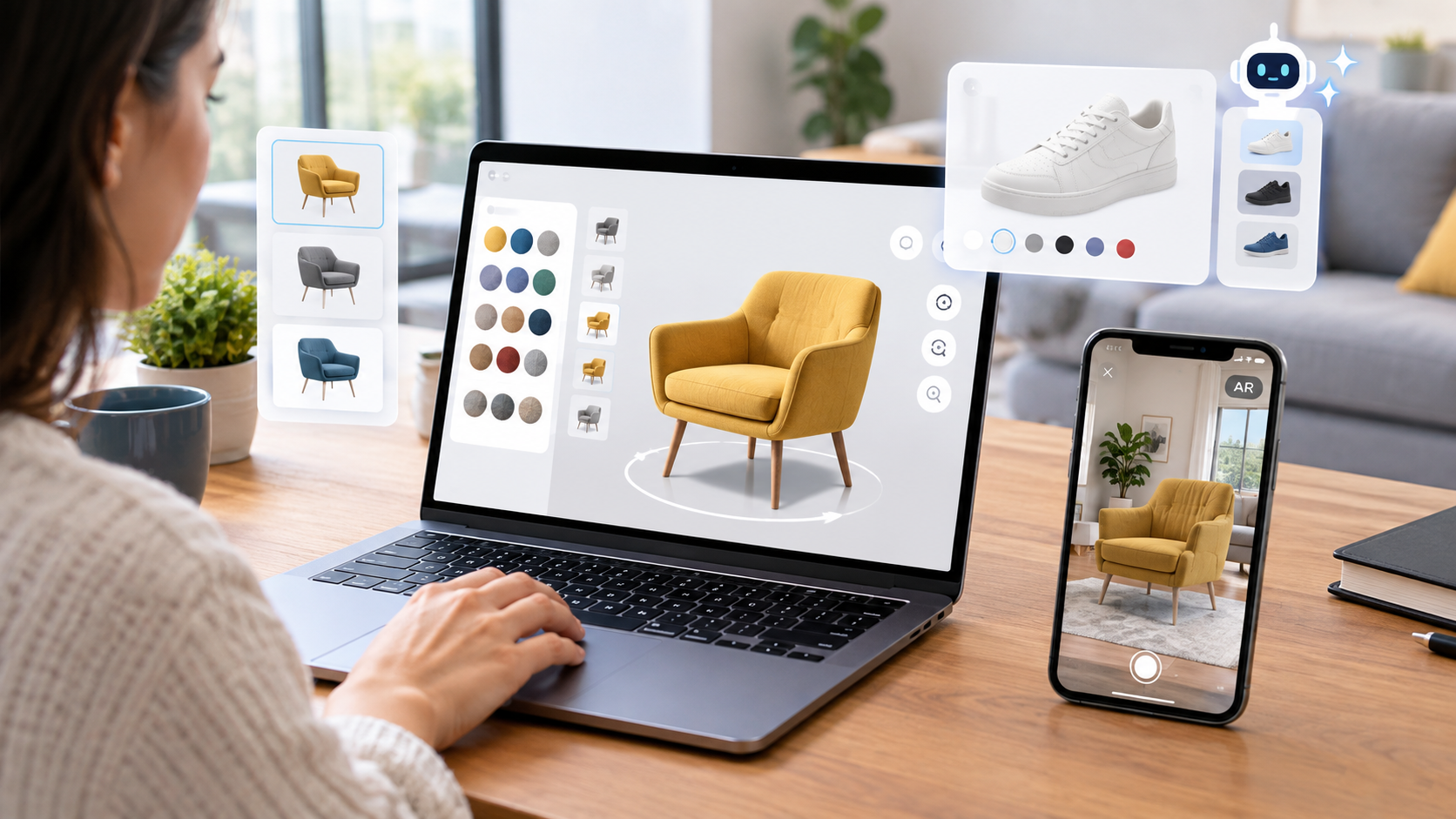
Online shopping has always had one obvious weakness. You can't touch anything. You can't rotate a chair to check the stitching, or see how a sneaker actually catches the light. For years, retailers tried to close that gap with better photography and longer product descriptions. It helped, but it never solved the core problem: static images can't answer the question "what if I chose it in a different color, size, or finish?"
That's the gap virtual product experiences are now filling, and the shift is happening faster than most shoppers realize.
The Problem With Flat Product Pages
A typical product page shows five or six photos, maybe a short video, and a wall of text. It works fine for simple items. It falls apart the moment a product has options. Furniture with multiple fabric choices, cars with dozens of trim levels, clothing in a dozen colorways none of that translates well to a static gallery. Shoppers end up guessing, and guessing leads to returns.
Return rates tell the story. Products with strong visual customization tend to see meaningfully lower return rates than products sold through static images alone, largely because buyers know what they're getting before it ships. That single fact has pushed a lot of retailers to rethink how they present configurable products.
What a 3D Product Configurator Actually Does
A 3d product configurator lets a shopper build a product on screen, piece by piece, and see the result in real time. Pick a material, change a color, swap a component, and the model updates instantly. No page reload, no waiting for a new photo to load. It's the closest thing to standing in a showroom that a browser tab can offer.
This isn't a gimmick reserved for luxury cars or high-end furniture anymore. Mid-market brands in apparel, home goods, and even construction materials are adopting configurators because the underlying tools have gotten cheaper and easier to deploy. A brand selling custom bookshelves can now offer the same kind of interactive experience that used to require a six-figure development budget.
Why Shoppers Respond to It
People trust what they can manipulate. When a shopper drags a slider and watches a product change shape or color, they form a stronger mental model of what they're buying than they would from scrolling past a dozen photos. That sense of control shortens the gap between curiosity and purchase, and it cuts down on the second-guessing that leads to abandoned carts.
There's also a simple entertainment factor. Configurators are engaging in a way that photo galleries aren't. Shoppers spend more time on pages that let them play around, and time spent on a page correlates strongly with purchase intent.
Product Visualizers Are Filling the Gaps Configurators Can't
Not every product needs full customization. Sometimes the goal is simpler: help someone picture an item in their own space or on their own body. That's where a product visualizer earns its keep. Think of a rug shopper uploading a photo of their living room floor, or a paint brand letting someone preview a wall color before buying a single can.
Visualizers solve a different problem than configurators. Configurators are about choice. Visualizers are about context. A shopper might love a sofa's design but still hesitate because they can't tell if it will overwhelm a small room. A visualizer answers that question directly, without requiring a return.
The Rise of the 3D Customizer in Everyday Retail
A few years ago, a 3d customizer was mostly a novelty for sneaker brands, letting customers pick their own colorways. That's changed. Customization tools now show up in eyewear, jewelry, phone cases, even kitchen cabinetry. The common thread is that customers increasingly expect some say in how a product looks before they hand over payment.
This expectation didn't come from nowhere. Once a shopper has used a well-built customizer on one site, a plain product page on another site starts to feel outdated by comparison. That's a quiet but real competitive pressure building across retail categories that haven't historically offered any customization at all.
AR Visualizer Tools Bring the Product Into the Room
Augmented reality has moved past the point of being an experimental add-on. An AR visualizer lets a shopper hold up their phone and see a piece of furniture sitting in their actual living room, or a lamp on their actual desk, scaled correctly and lit by the room's real lighting. It answers the "will this fit" question that has haunted online furniture and home goods sales for as long as they've existed.
The technology behind this has matured quickly. What once required a dedicated app now often runs directly in a mobile browser, which removes a huge amount of friction. Fewer downloads mean more people actually try the feature, and more people trying it means fewer surprises when the box arrives.
Where This Is Heading
None of these tools work in isolation forever. The next phase looks like convergence: a single interactive experience that lets a shopper configure a product, visualize it in their space, and preview it in AR, all without leaving one screen. Some retailers are already building toward that, blending configurators and visualizers into a single interactive layer rather than treating them as separate features bolted onto a product page.
For shoppers, the payoff is straightforward. Less guessing, fewer regrettable purchases, and a shopping experience that finally accounts for the fact that people like to see what they're buying before they buy it. For retailers, the payoff shows up in the numbers that matter most: fewer returns, longer time on site, and customers who feel more confident clicking "buy."
The shift from flat product pages to interactive, spatial shopping experiences isn't a trend that will reverse. It's simply catching e-commerce up to a standard that physical retail has always offered, and shoppers are noticing the difference.
- Goth Lifestyle
- Fashion & Style
- Music & Bands
- Art & Photography
- Creative Writing & Poetry
- Events & Scene
- Occult & Spirituality
- DIY & Tutorials
- Beauty & Self-Care
- Relationships & Dating
- Gaming & Media
- Tech & Gadgets
- Body Art & Piercings
- Underground Culture
- Spotlights & Interviews
- Travel & Places
- Lifestyle & Daily Life
- Fitness & Health
- Travel & Adventure
- Books & Literature
- Tech & Gaming
- Movies & TV
- Food & Drinks
- Humor & Memes
- Pets & Animals
- General Arts & Crafts

 English
 Arabic
 Spanish
 Portuguese
 Deutsch
 Turkish
 Dutch
Dutch
 Italiano
 Russian
 Romaian
 Portuguese (Brazil)
 Greek
Greek