


How does an Andrology Room Design Company reduce contamination risks?
Introduction
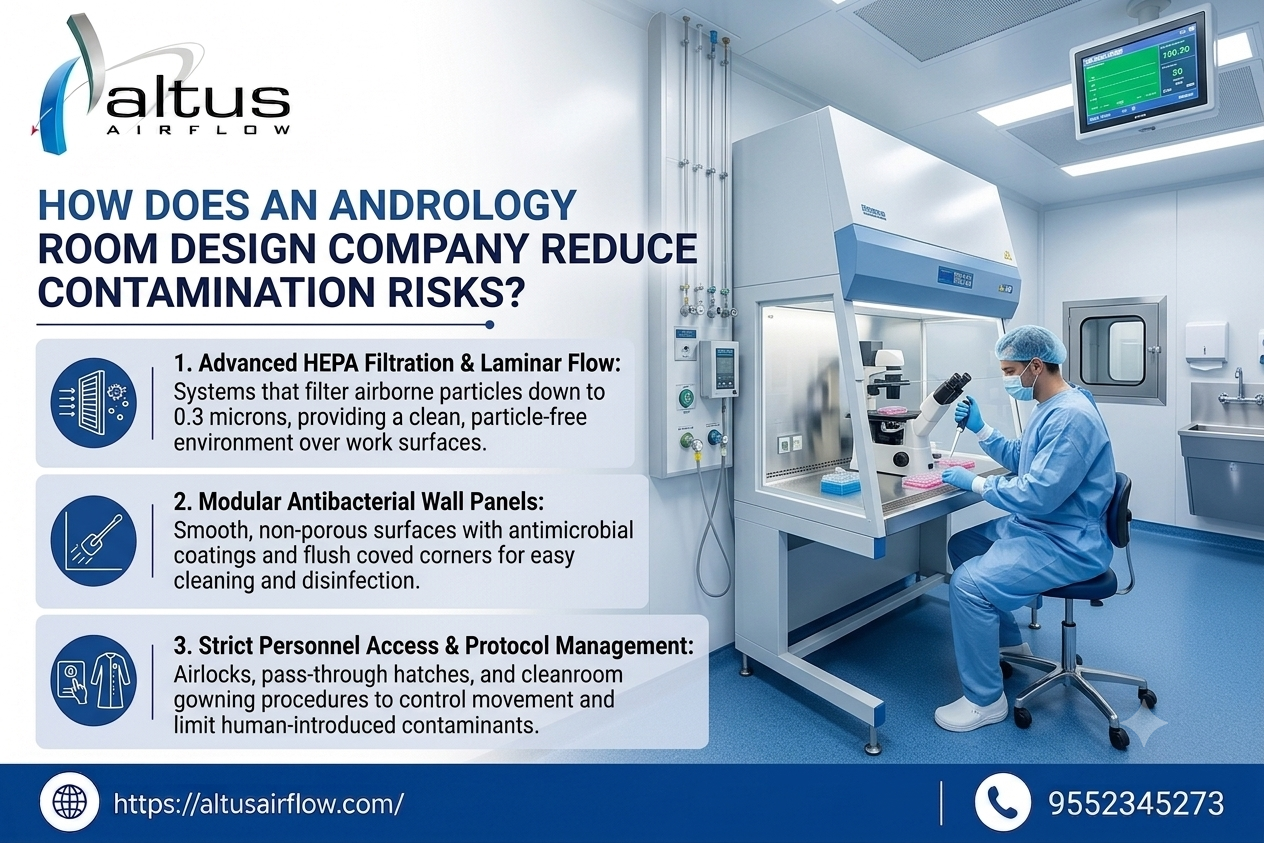
Altus Airflow focuses on developing specialized healthcare environments where controlled airflow, modular construction, HVAC systems, filtration, electrical infrastructure, and hygienic surfaces work together to support laboratory performance. Andrology laboratories require carefully controlled conditions because procedures involving reproductive samples can be sensitive to environmental variations and airborne contaminants. An Andrology Room Design Company can contribute to contamination-risk reduction by planning appropriate room layouts, airflow patterns, filtration systems, pressure relationships, material selections, and monitoring arrangements. The objective is to create an environment where potential contamination sources are controlled through coordinated facility design and engineering.
Contamination control in an andrology room involves more than installing air-conditioning equipment or using cleanable wall surfaces. HVAC performance, HEPA filtration, temperature and humidity control, personnel movement, equipment placement, cleaning practices, utility routing, and maintenance all influence the room environment. A well-planned facility should support controlled workflows while making cleaning, inspection, testing, and servicing practical. Proper commissioning and periodic performance checks are also important because the effectiveness of environmental systems can change over time. By addressing these factors together during planning and installation, hospitals and reproductive healthcare facilities can establish an environment designed to minimize avoidable contamination risks.
1. Understanding Contamination Risks in Andrology Rooms
Andrology rooms handle sensitive reproductive samples and laboratory procedures that require controlled environmental conditions. Potential contamination sources can include airborne particles, microorganisms, dust, inappropriate personnel movement, poorly maintained equipment, unsuitable surfaces, and uncontrolled airflow.
The design of the room should therefore consider how contaminants could enter, circulate, or accumulate. A coordinated approach involving room layout, HVAC, filtration, pressure control, cleaning, and monitoring can help reduce these risks.
2. Proper Room Layout and Workflow Planning
Room layout has a direct relationship with contamination control. An appropriately planned andrology room separates different activities and provides logical movement paths for staff, samples, equipment, and materials.
Unnecessary movement should be minimized, particularly around areas where sensitive procedures are performed. Storage locations, workstations, equipment, handwashing facilities, access points, and service areas should be positioned according to the intended workflow.
A well-planned layout can reduce unnecessary cross-movement and help staff maintain consistent working practices.
3. Controlled HVAC Systems
HVAC systems are central to maintaining controlled environmental conditions. Temperature, humidity, airflow, pressure relationships, and filtration need to be considered together rather than treated as independent systems.
An Andrology Room Design Company can plan HVAC infrastructure according to the room's functional requirements, including suitable air distribution, accessible maintenance arrangements, and appropriate environmental controls.
The system should also be designed so that servicing can be performed without unnecessarily disturbing critical laboratory operations.
4. HEPA Filtration
HEPA filtration can help reduce airborne particulate contamination by capturing very small particles from the air passing through the filter. The filtration system must be correctly selected, installed, sealed, and maintained to perform as intended.
Filter integrity testing is important because simply installing a HEPA filter does not establish that the complete filtration assembly is performing correctly.
Filters should also be replaced according to condition, test results, operating requirements, and manufacturer recommendations.
5. Controlled Airflow Patterns
Airflow direction and distribution can influence how airborne particles move within an andrology room. Poorly distributed air can create stagnant zones or undesirable air movement around work areas.
The HVAC system should therefore be designed to provide appropriate air distribution for the room configuration. Airflow measurements and visualization methods can help identify whether the intended pattern is being achieved.
Equipment, furniture, partitions, and other obstructions should also be considered because they can affect airflow after installation.
6. Temperature and Humidity Control
Maintaining appropriate temperature and humidity conditions is important for a controlled laboratory environment. Excessive humidity can contribute to condensation and may create conditions that encourage material deterioration or microbial growth.
Temperature fluctuations can also affect laboratory equipment and working conditions.
Automated sensors and environmental monitoring systems can provide continuous information about room conditions. Alerts can be configured where appropriate so that deviations can be identified and addressed promptly.
7. Pressure Differential Management
Pressure relationships between adjoining spaces can influence the movement of air and contaminants. Depending on the facility design and applicable requirements, pressure differences may be used to control airflow between rooms.
The pressure strategy should be established during the design stage rather than added after installation. Doors, air-transfer pathways, exhaust systems, and HVAC balancing all influence pressure performance.
Regular pressure checks can help confirm that the intended relationship between rooms continues to be maintained.
8. Hygienic Modular Wall and Ceiling Systems
Walls and ceilings in an andrology room should be easy to clean and resistant to the cleaning procedures used by the facility. Smooth, appropriately sealed surfaces can reduce areas where dust or contaminants may accumulate.
Joints, corners, penetrations, and service openings require particular attention because poorly finished areas can become difficult to clean.
A modular construction approach can also provide controlled installation of panels and service interfaces while allowing future modifications when required.
9. Proper Selection of Flooring and Other Surfaces
Flooring and other interior finishes should be selected according to laboratory use, cleaning requirements, durability, and resistance to commonly used cleaning agents.
Damaged or deteriorated flooring can create maintenance challenges and may provide areas where contaminants accumulate.
The junctions between floors and walls should also be properly detailed so that cleaning can be performed effectively without difficult-to-access gaps.
10. Personnel Movement and Access Control
People can introduce particles and microorganisms into controlled laboratory environments. For this reason, personnel movement should be considered during room planning.
Access points should be positioned to support the intended workflow, while unnecessary entry and exit should be minimized.
Where appropriate, access-control systems can help restrict entry to authorized personnel. Staff should also follow established gowning, hygiene, and laboratory procedures as part of the overall contamination-control strategy.
11. Equipment Placement
Laboratory equipment can influence airflow, cleaning access, and personnel movement. Large equipment positioned directly below or near air outlets may affect the intended airflow pattern.
Equipment should therefore be placed according to both operational requirements and environmental considerations.
Adequate clearance should be maintained where necessary for cleaning, inspection, servicing, and ventilation. Equipment layouts should also consider future replacement or upgrades.
12. Air Quality Monitoring
Environmental monitoring provides information about whether the room continues to operate within its intended conditions. Depending on the facility requirements, monitoring may include temperature, humidity, pressure, airflow, particle levels, and other applicable parameters.
Digital monitoring systems can provide continuous readings and maintain historical records. This can help facility teams identify trends and investigate deviations.
Monitoring does not replace proper design or maintenance, but it can provide useful evidence of environmental performance.
13. Proper Ventilation and Air Changes
Ventilation requirements should be established according to the room's intended use and applicable design criteria. Adequate air movement can help dilute and remove airborne contaminants while supporting environmental control.
The actual air-change performance should be verified after installation rather than assumed from equipment specifications alone.
Air balancing can help ensure that the designed airflow quantities are being delivered to the appropriate spaces.
14. Sealing of Joints and Service Penetrations
Small gaps and poorly sealed penetrations can create difficulties in maintaining a controlled room environment. Electrical cables, medical utilities, data connections, ducts, and other services may pass through walls or ceilings.
These penetrations should be properly detailed and sealed using suitable materials. The objective is to maintain the integrity of the room envelope while allowing necessary services to enter the space.
During inspections, joints, panel connections, doors, windows, and service penetrations should be checked for deterioration.
15. Cleaning and Disinfection Considerations
Facility design should support regular cleaning and disinfection. Surfaces should be accessible, durable, and compatible with approved cleaning procedures.
Cleaning staff should follow manufacturer recommendations for modular panels, flooring, equipment surfaces, and other installed materials. Excessive use of unsuitable chemicals can damage surfaces and create additional maintenance problems.
A well-designed room makes routine cleaning practical instead of relying on difficult-to-access areas.
16. Environmental Monitoring and Alarm Systems
Modern andrology facilities can incorporate centralized environmental monitoring systems. These systems can collect information from temperature, humidity, pressure, and other sensors.
When a parameter moves outside its configured range, an alarm or notification can alert responsible personnel. This can help reduce the time between a deviation occurring and corrective action being initiated.
Sensor calibration is also important because inaccurate sensors can produce misleading environmental readings.
17. Testing and Commissioning
Testing and commissioning should be completed before the room is placed into routine operation. HVAC airflow, temperature, humidity, pressure differentials, filtration, controls, and other relevant systems should be checked against their intended performance requirements.
HEPA filter integrity testing and airflow measurements may be included where applicable. Any deviations identified during testing should be investigated and corrected before final handover.
Proper commissioning provides documented evidence that the installed systems have been checked and adjusted.
18. Periodic Validation and Performance Checks
Contamination control is not a one-time installation activity. Environmental conditions can change because of equipment modifications, filter loading, HVAC deterioration, construction activity, or changes in room usage.
Periodic performance checks can help identify these changes. Depending on facility requirements, testing may include airflow, pressure, temperature, humidity, filtration, and environmental monitoring systems.
Maintaining historical test records allows hospitals to compare current results with previous measurements and identify developing trends.
19. Maintenance of HVAC and Filtration Systems
Preventive maintenance is essential for maintaining environmental performance. Filters, fans, coils, dampers, sensors, ducts, controls, and other HVAC components require inspection and servicing.
Neglected maintenance can gradually affect airflow quantity, temperature control, pressure relationships, and filtration performance.
Maintenance schedules should be based on equipment requirements, operating conditions, manufacturer recommendations, and facility procedures.
20. Managing Future Modifications
Laboratories may need new equipment, additional electrical connections, updated monitoring systems, or changes to workflow over time. Unplanned modifications can potentially disturb established environmental conditions.
An Andrology Room Design Company can incorporate accessible service routes and flexible infrastructure during the initial planning stage to make future changes easier to manage.
Any major modification should be reviewed for its potential impact on airflow, pressure, electrical loads, equipment placement, and contamination-control measures.
21. Documentation and Quality Control
Detailed documentation supports long-term contamination-control management. Hospitals should retain HVAC drawings, equipment specifications, filter information, commissioning reports, test results, maintenance records, calibration certificates, and modification records.
Quality-control documentation can also help facility teams identify the original design intent and determine whether later changes have affected system performance.
Clear records make troubleshooting and periodic assessments more efficient.
22. Importance of Integrated Design
Contamination control works best when different building systems are planned together. HVAC cannot be considered separately from room layout, modular construction, electrical systems, equipment positioning, access, and maintenance.
An Andrology Room Design Company can coordinate these elements during the design and installation stages so that individual systems do not unintentionally interfere with one another.
For example, equipment placement can affect airflow, while ceiling-mounted services can influence air distribution and maintenance access. Integrated planning helps address these interactions before installation.
23. Staff Practices and Facility Management
Engineering controls are only one part of contamination-risk management. Staff behavior, cleaning procedures, access control, equipment maintenance, and adherence to laboratory protocols also influence environmental conditions.
Personnel should understand room-entry procedures, hygiene requirements, cleaning practices, equipment operation, and responses to environmental alarms.
Regular training and clear standard operating procedures can support consistent facility operation.
24. Benefits of a Well-Planned Andrology Room
A properly planned andrology room can provide several operational benefits, including:
-
Better control of environmental conditions.
-
Reduced opportunities for airborne contamination.
-
Easier cleaning and maintenance.
-
More organized personnel and sample movement.
-
Improved monitoring of temperature and humidity.
-
Better management of airflow and pressure relationships.
-
Easier HVAC servicing and filter replacement.
-
Improved documentation of environmental performance.
-
Greater flexibility for future equipment upgrades.
-
More consistent laboratory operating conditions.
These benefits depend on appropriate design, installation, operation, maintenance, and ongoing performance verification.
Conclusion
Reducing contamination risks in an andrology room requires coordinated planning of airflow, filtration, room layout, hygienic materials, environmental monitoring, equipment placement, cleaning access, and maintenance. No single system can control every contamination risk, so hospitals should consider the complete environment and the operational procedures used within it. Regular testing, validation, preventive maintenance, and staff practices are also important for maintaining the intended conditions over time.
For healthcare facilities, working with Altus Airflow can support an integrated approach to andrology room planning, HVAC, modular construction, filtration, monitoring, and environmental control. With appropriate engineering, commissioning, documentation, and maintenance, Altus Airflow can help facilities develop controlled laboratory environments that are designed to minimize avoidable contamination risks and remain adaptable to future requirements.
Frequently Asked Questions
1. How does an Andrology Room Design Company reduce contamination risks?
An Andrology Room Design Company can reduce contamination risks through controlled HVAC systems, HEPA filtration, appropriate airflow patterns, pressure management, hygienic surfaces, proper room layout, environmental monitoring, testing, and preventive maintenance.
2. Why is HEPA filtration important in an andrology room?
HEPA filtration helps remove airborne particles from the air and can contribute to maintaining a controlled laboratory environment when properly installed, tested, and maintained.
3. Does room layout affect contamination control?
Yes. Proper zoning and workflow planning can reduce unnecessary movement and help limit opportunities for cross-contamination.
4. How does HVAC help control contamination?
HVAC systems manage airflow, filtration, temperature, humidity, and pressure relationships, which can help maintain controlled environmental conditions.
5. Is regular testing required after installation?
Periodic testing can help verify that airflow, filtration, temperature, humidity, pressure, and other relevant systems continue to perform as intended.
Read Our Previous Blog --------------->What automation features are available in Andrology Room Design?
- Goth Lifestyle
- Fashion & Style
- Music & Bands
- Art & Photography
- Creative Writing & Poetry
- Events & Scene
- Occult & Spirituality
- DIY & Tutorials
- Beauty & Self-Care
- Relationships & Dating
- Gaming & Media
- Tech & Gadgets
- Body Art & Piercings
- Underground Culture
- Spotlights & Interviews
- Travel & Places
- Lifestyle & Daily Life
- Fitness & Health
- Travel & Adventure
- Books & Literature
- Tech & Gaming
- Movies & TV
- Food & Drinks
- Humor & Memes
- Pets & Animals
- General Arts & Crafts

 English
 Arabic
 French
 Spanish
 Portuguese
 Turkish
 Dutch
Dutch
 Italiano
 Russian
 Romaian
 Portuguese (Brazil)
 Greek
Greek