


What Makes an Armored Hoodie Actually Protective? CE Rating, Aramid Coverage, Armor Fit and Retention
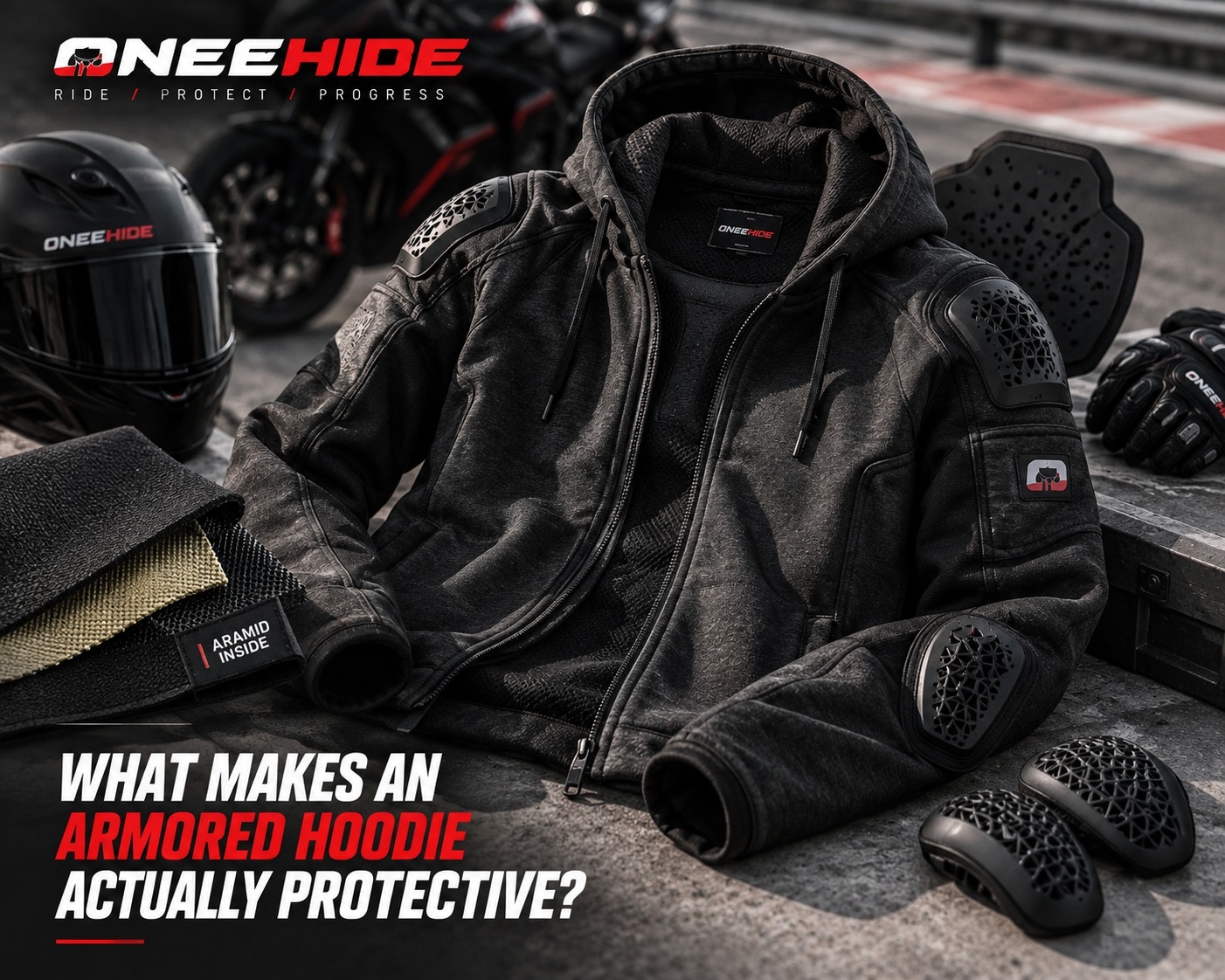
An armored motorcycle hoodie can look almost identical to ordinary streetwear while being built very differently underneath. That visual similarity is part of the appeal, but it also makes protective quality harder to judge from appearance alone.
A thick outer fabric, the word “Kevlar,” or a pair of removable pads does not automatically tell a rider how the garment will behave during a fall. Protection comes from a system: abrasion-resistant construction, impact protectors, secure armor positioning, strong seams and closures, appropriate coverage, and a fit that keeps those elements where they belong.
A Protective Hoodie Is More Than a Hoodie With Armor
The most useful way to evaluate an armored hoodie is to separate its protective functions.
The shell and reinforcement layers are primarily responsible for resisting abrasion, tearing, and structural failure during a slide. Impact protectors at areas such as the shoulders and elbows are intended to reduce the force transmitted during impact. The garment itself must then keep those components correctly positioned.
When comparing protective riding hoodies, riders should therefore look beyond styling and ask what the complete construction actually provides: where reinforcement is placed, what armor is supplied, how it is retained, and whether the garment has been tested or certified as a complete motorcycle protective garment.
That distinction matters because a hoodie containing certified armor is not automatically the same thing as a certified protective garment.
What Does a CE Rating on Motorcycle Clothing Actually Mean?
For motorcycle jackets, trousers, suits, and similar protective garments sold within the relevant European PPE framework, EN 17092 is the key family of standards used to classify protective motorcycle clothing.
The standard evaluates more than the presence of a particular fiber. Testing can include impact abrasion resistance, tear strength, seam strength, closures, protector positioning and fixation, dimensional stability, fit, and ergonomics. SATRA describes EN 17092 as covering protective garments through five performance classes, AAA, AA, A, B, and C.
Riders who want the technical background can review the EN 17092 motorcycle garment testing overview from SATRA.
Understanding AAA, AA, A, B, and C
The letters are garment classifications, not armor levels.
Class AAA represents the highest protection level within the EN 17092 series for garments addressing abrasion and impact risks. The higher requirements can involve compromises in weight, thermal comfort, flexibility, or general convenience.
Class AA sits below AAA and is intended to provide protection suitable for a broad range of riding activities while generally allowing fewer ergonomic penalties than AAA equipment.
Class A uses lower protective requirements than AA and AAA and is commonly associated with garments where lighter weight and greater everyday comfort are priorities.
Two additional classes serve different purposes:
-
Class B garments provide abrasion protection equivalent to the relevant Class A requirements but do not include the impact protectors required to provide the complete minimum impact protection associated with an A garment.
-
Class C garments are designed primarily to hold impact protectors and do not provide the minimum abrasion protection of the shell garment classes.
This means the highest letter is not automatically the right garment for every rider. A commuter who will actually wear a comfortable protective garment every day faces a different practical decision from a rider choosing equipment for much more demanding riding. The classification tells you the tested performance category. Your riding conditions determine what level of protection and comfort trade-off makes sense.
CE-Certified Armor Is Not the Same as a CE-Rated Garment
This is one of the easiest labeling distinctions to miss.
A manufacturer can use impact protectors that comply with an EN 1621 standard while the surrounding hoodie has different certification or testing status. The protector certification tells you about the tested impact performance of that protector. It does not, by itself, establish the abrasion resistance, seam strength, tear resistance, or structural integrity of the complete hoodie.
The European Commission identifies Regulation (EU) 2016/425 as the applicable PPE framework in the EU, while individual standards provide technical routes for assessing particular categories of protective equipment.
For a buyer, the practical question is simple: Is the label referring to the armor, the complete garment, or both?
How Much Does Aramid Coverage Matter?
Aramid reinforcement is frequently discussed in motorcycle hoodies because high-strength fibers can form part of an abrasion-resistant construction. What matters, however, is not simply whether the word “aramid” appears in the product description.
Coverage matters because different parts of a rider's upper body can experience different combinations of impact, abrasion, and tearing during a crash.
Partial Reinforcement and Full-Garment Performance Are Different Questions
A hoodie may use additional protective material only at selected locations, such as the elbows, shoulders, or back. Another construction may use reinforcement across a much larger proportion of the garment.
Neither layout should be judged purely by the percentage of aramid advertised. The more important question is whether the complete material system provides appropriate protection in the areas where it is required.
EN 17092 uses risk-based garment zones and assesses material combinations at different levels according to the garment class. SATRA's description of the abrasion procedure also notes that the weakest relevant material combinations are tested and that the layer closest to the body must avoid prohibited hole formation during the test.
That is why statements such as “aramid lined” need context. Riders should ask:
-
Which areas are actually reinforced?
-
Is the reinforcement continuous across high-risk areas?
-
What materials sit over and under it?
-
How are the layers connected?
-
Has the complete garment achieved a recognized protective classification?
A fiber name alone cannot answer those questions.
Seams Can Be as Important as the Fabric Between Them
A highly abrasion-resistant panel has limited value if the construction joining it to the rest of the garment fails early.
Protective garment assessment therefore includes structural elements rather than focusing solely on surface fabric. EN 17092 testing addresses seam strength, structural closures, tear resistance, and protector-pocket construction as part of the overall garment assessment.
This is especially relevant to casual-looking motorcycle clothing. Streetwear design often uses multiple panels, pockets, cuffs, decorative seams, zippers, and stretch sections. Every additional construction detail has to coexist with the garment's protective role.
Why Armor Fit and Retention Matter So Much
Impact armor can only protect the intended area effectively if it remains over that area when it is needed.
Shoulder armor that sits too far behind the shoulder, or elbow armor that rotates around the arm, may leave part of the intended impact zone exposed. A protector that feels perfectly positioned while standing may also shift once the rider reaches forward to the handlebars.
EN 17092 addresses this problem by requiring protectors to be positioned so they cover the appropriate body part according to the relevant impact-protector standard. The garment standard also assesses fit, ergonomics, and restraint features.
Check Armor Position in a Riding Posture
Trying on an armored hoodie should involve more than looking in a mirror.
Put the hoodie on, close it as it would be worn on the motorcycle, then adopt your normal riding position. Bend your elbows, reach forward, rotate your shoulders, and move through the range of motion you would use on the bike.
The elbow protector should remain centered around the joint rather than sliding substantially toward the forearm or rotating to one side. Shoulder protectors should remain positioned over the shoulder instead of hanging loosely behind or below it.
A garment can feel comfortable while walking around a shop yet fit poorly once the arms are extended.
Excessive Looseness Can Work Against Protection
Armored hoodies naturally aim for a more casual silhouette than tightly fitted race equipment. That does not mean loose armor should be accepted.
Protector pockets, sleeve shape, adjustment systems, and overall sizing all influence how easily armor can move. The objective is not to make the garment uncomfortably tight. It is to reduce unnecessary movement while preserving the mobility required to control the motorcycle.
SATRA's EN 17092 overview notes that garment fit is assessed against the manufacturer's sizing information and that the wearer must be able to perform the required movements. Sleeve restraint is also specifically tested within the standard.
Good protective fit is therefore a balance: secure enough to retain protection, flexible enough to ride normally.
What Do Level 1 and Level 2 Motorcycle Protectors Mean?
Armor performance is assessed separately from the A, AA, and AAA garment classification.
EN 1621-1 covers limb-joint impact protectors used at locations such as the shoulders and elbows. The standard defines two performance levels. In impact testing, lower transmitted force represents better impact attenuation, with Level 2 representing the higher protective performance category.
The EN 1621 impact protector guidance from SATRA explains the testing framework for limb, back, chest, and inflatable motorcycle protectors.
A Level 2 protector may offer improved impact attenuation, but buyers should not evaluate the number in isolation. Protector size, coverage, thickness, flexibility, ventilation, pocket compatibility, and retention all affect how practical the armor is in a particular hoodie.
A high-performing protector that repeatedly moves away from the joint is not an ideal setup. Nor is extremely bulky armor useful if it makes the garment so uncomfortable that the rider routinely removes it.
What Should You Check Before Buying an Armored Motorcycle Hoodie?
Marketing descriptions can be useful, but the product label and technical information deserve more attention.
Start with the complete garment rather than a single feature.
Check the garment classification. If an EN 17092 class is claimed, identify whether it is A, AA, AAA, B, or C. Do not interpret “CE armor” as proof that the entire hoodie has the same certification.
Identify the supplied armor. Determine which protectors are included at the shoulders and elbows, what EN standard and performance level they meet, and whether additional back or chest protection can be fitted if that matters to you.
Inspect reinforcement coverage. Find out exactly where the abrasion-resistant construction is located rather than relying on a fiber name in the headline.
Look at armor-pocket security. Protectors should sit in defined positions with minimal unwanted rotation or vertical movement.
Evaluate the hoodie in riding position. Extend your arms, bend your elbows, turn your torso, and check whether protective areas remain where expected.
Consider closures and exposed areas. The garment should remain appropriately secured rather than easily pulling or riding upward during normal movement.
Read care instructions. Protective clothing is a technical product. Cleaning, heat, alteration, and incorrect replacement components can affect materials, sizing, or protector positioning.
The protective value of motorcycle clothing is also why official rider guidance consistently recommends appropriate protective garments rather than ordinary lightweight casual clothing. For example, UK government motorcycle training guidance distinguishes suitable protective clothing from lightweight hoodies and other garments that provide inadequate protection for riding.
Choose the Construction, Not the Marketing Label
The safest way to judge an armored hoodie is to stop asking whether it “has Kevlar” or “comes with CE armor” and start asking how the complete protective system works.
Look for a defensible garment classification where applicable, suitable abrasion-resistant construction, meaningful reinforcement coverage, strong seams and closures, correctly rated impact protectors, secure armor pockets, and a fit that keeps protection aligned while riding.
Then weigh those features against the reason you want a hoodie in the first place. Everyday motorcycle clothing often exists because riders want greater comfort, mobility, and streetwear styling than traditional riding equipment. Those benefits are legitimate, but they should be considered alongside the garment's verified protective performance.
A protective hoodie does not become effective because one impressive material or certification term appears on the tag. Its protection depends on how the materials, armor, construction, coverage, and fit work together when the rider actually needs them.
- Goth Lifestyle
- Fashion & Style
- Music & Bands
- Art & Photography
- Creative Writing & Poetry
- Events & Scene
- Occult & Spirituality
- DIY & Tutorials
- Beauty & Self-Care
- Relationships & Dating
- Gaming & Media
- Tech & Gadgets
- Body Art & Piercings
- Underground Culture
- Spotlights & Interviews
- Travel & Places
- Lifestyle & Daily Life
- Fitness & Health
- Travel & Adventure
- Books & Literature
- Tech & Gaming
- Movies & TV
- Food & Drinks
- Humor & Memes
- Pets & Animals
- General Arts & Crafts

 English
 Arabic
 French
 Spanish
 Portuguese
 Turkish
 Dutch
Dutch
 Italiano
 Russian
 Romaian
 Portuguese (Brazil)
 Greek
Greek